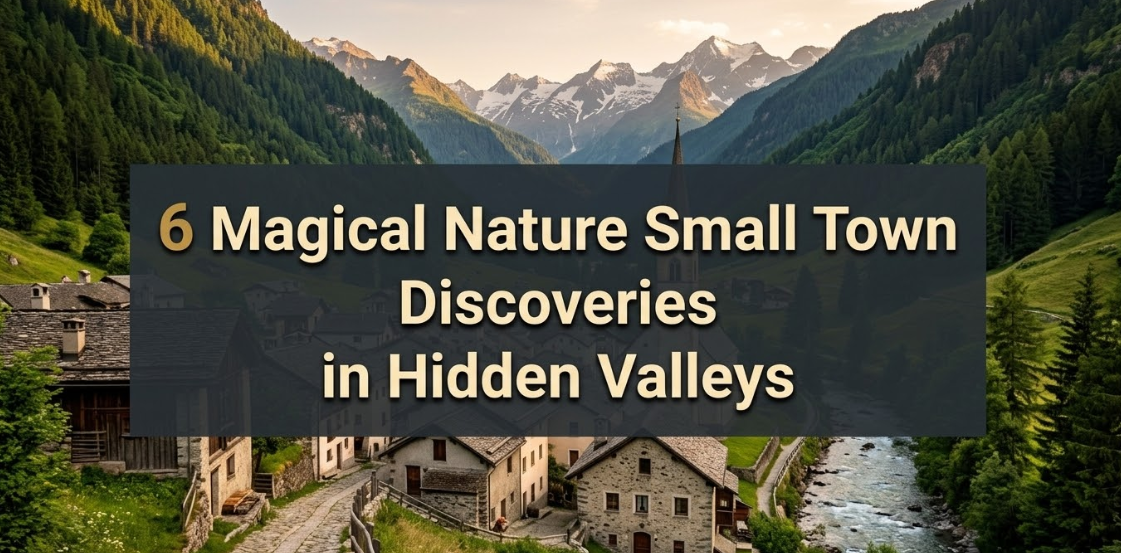
Some of the most beautiful places in the world are hidden away in quiet valleys — far from busy highways and crowded tourist destinations. These small towns have secrets that few travelers ever learn. This is the guide for you, if you’re a nature-loving fresh air fiend who loves peace of mind that actually refreshes your brain.
Nature small town discoveries are trending as more travelers seek experiences that feel authentic and slow. These valley towns provide that rare opportunity to slow down, take a deep breath and connect with the natural world in a way that no big city could ever hope to offer.
So let’s embark on a tour of six enchanting small towns in quiet valleys around the world. Each has its own personality, its own magic and its own reason to visit.
6
Hidden valley towns
72%
Travelers prefer off-beat destinations
3x
More stress-reduction vs city trips
500+
Avg. unique plant species per valley
Why Quiet Valley Towns Are Hot in Nature Travel
In the past decade, travelers from around the globe have been pulling away from overcrowded cities and overhyped attractions. Data from travel platforms shows a steady increase in searches for “small town nature retreats” and “quiet valley destinations.”
People are exhausted from standing in long lines and paying premium tickets for experiences that feel artificial. A walk through a foggy valley village or a peaceful dawn alongside an alpine stream feels different. It’s honest, calm and actually beautiful.
If you’re looking for more hidden gems like these, Small Town Discoveries is a dedicated resource for travelers seeking authentic small-town experiences off the beaten path.
Discovery 01
Hallstatt, Austria — The Alps and Mirror-Perfect Water
Hallstatt perches on the edge of a deep, clear body of water in Austria’s Salzkammergut. Mountains loom on all sides, and the little wooden houses lining the shore seem to be in a painting.
It’s not just the aesthetics that make Hallstatt special. This settlement has been occupied for more than 7,000 years. Salt miners, farmers and fishermen have formed its culture through thousands of years. Today, visitors can still walk the same narrow lanes that generations past traversed.
What Nature Gives You Here
- The Hallstatt-Dachstein region has been recognized as a UNESCO World Heritage Site
- Sparkling Hallstätter See lake, great for kayaking
- The Echern Valley trail traverses waterfalls and alpine meadows
- In spring, rare alpine flowers and wild orchids bloom among the mountains
Travel tip: Go in the early morning or late evening. Midday, the crowds cram near the lake — but a short walk uphill sweeps you into utter silence, enveloped by forest and birdsong.
Discovery 02
Jiufen, Taiwan — Lanterns, Mist and Pathways in the Woods
Sitting on a hillside in northeastern Taiwan, Jiufen is a town that seems to live between two worlds. Stone staircases snake between tea houses, ancient temples and red lanterns that glow warmly in daylight.
The town perches above a valley that frequently fills with low morning clouds. Looking out from the hillside, you feel like you’re standing above the land itself. The nearby Keelung Mountain and Teapot Mountain have hiking trails that provide vistas of both the valley and the Pacific Ocean in the distance.
Nature Highlights of Jiufen Valley
- Mountain trails wrapped in clouds every morning during winter and spring
- Subtropical rainforest covering the valley sides
- Nearby Gold Ecological Park, with river walking and wildlife
- April–May: Firefly season — a real valley spectacle
Travel tip: Jiufen’s firefly season attracts locals but few foreign tourists. Head to the valley paths at dusk in April for one of nature’s most magical displays of light — completely free and deeply memorable.
Town to Town: What Nature Lovers Find in Each Town
To help you choose which valley town is right for your travel style, here’s a quick rundown of all six towns featured in this guide.
| Town | Country | Best Season | Top Nature Feature | Difficulty |
|---|---|---|---|---|
| Hallstatt | Austria | Spring / Autumn | Alpine lake & glaciers | Easy |
| Jiufen | Taiwan | Spring (fireflies) | Misty hillside forest | Moderate |
| Monteriggioni | Italy | Late Spring | Cypress-lined valleys | Easy |
| Wachau Valley Towns | Austria | Summer / Autumn | River & vineyard trails | Easy |
| Glendalough | Ireland | Spring / Summer | Ancient valley lakes | Moderate |
| Valle de Cocora | Colombia | Dec – Feb | World’s tallest palms | Challenging |
Discovery 03
Monteriggioni, Italy — A Walled Town Enfolded in Tuscan Green
Monteriggioni is a tiny medieval town in Tuscany, sitting on top of a round hilltop and entirely surrounded by ancient stone walls. Step outside those walls and you walk straight into one of the most beautiful landscapes on earth.
Rolling green hills, fields of golden wheat, rows of pencil-straight cypress trees and vineyards that stretch to the horizon — this is the Tuscany of postcards come to life. The valley below the town is laced with dirt paths that invite slow, quiet walks.
Nature Discoveries Around the Walls
- The Via Francigena pilgrim walkway passes directly through the valley
- Wild poppies blanket the fields from April to June
- Olive groves with trees over 200 years old
- Local owls, foxes and hoopoe birds are often spotted at dawn
Travel tip: You can see the town in less than 30 minutes. Take a full day to walk the valley trails and have lunch on a hillside with views for miles around. Bring a simple picnic feast from the local deli.
Best Way to Plan Your Nature Small Town Discovery Trip
1
Pick your season firstEach valley has a prime nature moment — fireflies, blooms, harvest, snow. Align your travel dates with the natural calendar.
2
Book accommodation in or around the townStaying inside the valley means you get to soak up the magic at dawn and dusk — the best experience that most day-trippers miss.
3
Research one longer trail each dayDon’t over-schedule. One good walk a day, local food and time to simply sit outside gives the best experience.
4
Travel light and pack your reusablesSmall towns have small shops. Bring a reusable water bottle and bags. Pack in and pack out — keep natural areas natural.
5
Ask locals, not just guidebooksThe best swimming hole, the quietest trail, the family-run restaurant — locals always know what the internet doesn’t.
Discovery 04
Wachau Valley Villages, Austria — Castles, Rivers and Wild Apricots
The Wachau Valley traces the curve of the Danube River in Lower Austria. Tiny wine villages — Dürnstein, Weissenkirchen, Spitz — lie between terraced vineyards and forested cliffs. It’s another UNESCO World Heritage landscape, and with good reason.
What makes the Wachau special is the combination of river, ruin and orchard. Every few kilometers sits a crumbling castle looking down on the water. In spring, apricot trees burst into pink and white blossom, perfuming the valley. In autumn, the vines turn amber and orange.
Why Nature Travelers Love the Wachau
- The Danube hiking and cycling trail runs the full length of the valley
- Rare Middle European riverside flora lines the river paths
- Bird watching spots for kingfishers, black storks and ospreys
- Wachau apricot jam and local wine — made from the very land you’re walking through
Travel tip: Rent a bicycle in Krems and ride the valley from end to end. Stop wherever looks good. The entire route is mostly flat, traffic is low and every turn brings something unexpected.
Discovery 05
Glendalough, Ireland — Two Lakes in a Wild Green Valley
Glendalough — meaning “valley of two lakes” in Irish — lies deep in the Wicklow Mountains. It’s a place where ancient monastic ruins stand quietly beside dark, still lakes and oak woodlands that have hardly changed in centuries.
The valley has a particular quality of light and silence. Thick forest surrounds both lakes. Most mornings, mist rolls down the slopes of the mountains. The old stone round tower, built over a thousand years ago, looks out over all of it.
Nature in the Valley of Two Lakes
- Ancient sessile oak woodland — among Ireland’s most complete native forests
- Red deer often spotted on valley slopes at dawn and dusk
- Peregrine falcons nest on the cliff faces above the upper lake
- The Wicklow Way long-distance trail passes directly through the valley
Travel tip: Many visitors only hike as far as the lower lake. Continue on to the upper lake for a much wilder experience — rocky shores, cliffs and almost no crowds, even in summer.
Discovery 06
Valle de Cocora, Colombia — The Valley of the Giant Palms
If you want to feel really small in nature’s presence, Colombia’s coffee region is where Valle de Cocora will do it. This valley contains the wax palm — the tallest palm tree in the world — with some stretching over 60 meters high.
The little town of Salento sits at the entrance to the valley. It’s colorful, hospitable and bubbling with coffee culture. But it’s the hike into the valley itself that transforms you. Walking through a cloud forest and emerging into a wide green meadow pierced by impossibly tall palms that stretch up into low cloud — nothing on earth is quite like it.
Why Cocora Valley Is So Special
- The wax palm, national tree of Colombia, seen in its natural habitat
- Cloud forest hummingbirds, including the rare sword-billed hummingbird
- Full-day circular hike through forest and open valley
- Andean condors occasionally seen soaring off the ridgelines
Travel tip: Get an early start on the hike — 6 or 7am if you can. By mid-morning the valley fills with cloud, which is lovely, but visibility decreases. The clear early morning offers you the full sky-high palm experience.
Best Time of Year to Visit Each Town — At a Glance
Visiting in tune with nature’s rhythms makes all the difference. Here’s a simplified look at the ideal travel windows for each destination. According to National Geographic Travel, timing your visit to coincide with local natural events — like blossom season or wildlife migrations — consistently produces the most memorable travel experiences.
| Town | Peak Nature Months | Nature Experience Score (out of 10) |
|---|---|---|
| Hallstatt | April – May, September – October | 9 / 10 |
| Jiufen | April – May (firefly season) | 9 / 10 |
| Monteriggioni | April – June | 8 / 10 |
| Wachau Valley | June – September, October | 9 / 10 |
| Glendalough | April – August | 8 / 10 |
| Valle de Cocora | December – February | 9 / 10 |
What to Take With You on a Nature Valley Town Trip
You don’t need fancy gear for many of these places. But a few smart choices make a real difference.
| Item | Why It Matters | Priority |
|---|---|---|
| Layered clothing | Valley mornings can be chilly; afternoons heat up quickly | Essential |
| Waterproof jacket | Mountain weather shifts without warning | Essential |
| Good walking shoes | Cobblestones, forest paths and river trails all demand grip | Essential |
| Reusable water bottle | Stay hydrated on trails; reduces plastic waste | Essential |
| Small binoculars | Bird watching and viewing distant landscape detail | Recommended |
| Offline maps downloaded | Cell service is patchy around most valleys | Essential |
| Local currency cash | Small towns rarely have card machines at trail shops | Recommended |
Why These Valley Towns Have the Power to Change You
Nature small town discoveries aren’t just about pretty photos. Studies consistently show that spending time in quiet, natural settings has measurable benefits for mental and physical health.
Science-backed benefits of nature valley travel
- Cortisol (stress hormone) levels drop after just 20 minutes in a natural environment
- Stanford research shows up to 60% improvement in creative thinking when slow walking in nature
- Research has shown that listening to birdsong can reduce anxiety and improve mood
- Spending time in forests measurably boosts immune system function through phytoncides
When you walk through Glendalough at dawn with mist on the water, or stand below Cocora’s wax palms as hummingbirds whirr around your head, something really shifts. The body relaxes. The mind quiets. Things that seemed urgent all of a sudden feel manageable.
And that isn’t merely a nice feeling. It’s biology doing what it was designed to do — in nature, at a human pace.
Traveling Responsibly in Small Valley Towns
These towns are special in part because they haven’t been overrun. Every visitor is responsible for keeping them that way.
- Stick to established trails to protect sensitive plant life
- Eat and buy from local producers, not chains
- Keep noise low in wooded areas — wildlife relies on silence
- Pack out all of your rubbish if no bins are available
- Follow posted signs about wildlife or protected areas
Frequently Asked Questions
What are nature small town discoveries in quiet valleys?
They are small, frequently lesser-known hamlets nestled into valley landscapes surrounded by mountains, rivers, forests or meadows. These towns offer outstanding natural scenery and a peaceful, laid-back atmosphere that is very different from mainstream tourist destinations.
Which of these six towns is best for first-time nature travelers?
Hallstatt in Austria and the villages of Wachau Valley are ideal for first-timers. Both are extremely accessible, with good infrastructure and breathtaking natural beauty without requiring strenuous hiking. Glendalough in Ireland is another great choice for beginners.
Are these little valley towns family-friendly for young children?
Most of them, yes. Hallstatt, Monteriggioni and the Wachau Valley are very family-friendly. Valle de Cocora in Colombia is better for older kids and teens because the main hike involves long hours on foot and uneven terrain. Always research trail conditions beforehand.
How much time should I allocate to each town?
Most of these towns merit two to three nights for an authentic nature experience. This allows you to wander at a leisurely pace — including an early morning walk, when nature is at its most active and most beautiful.
Should I book these trips well in advance?
For high seasons — particularly Hallstatt during summer and Jiufen during firefly season — booking three to six months in advance is highly recommended. Off-season visits (spring and autumn) tend to have far more flexibility and considerably fewer crowds.
What’s the most budget-friendly option on this list?
Glendalough in Ireland and Valle de Cocora in Colombia are both very affordable. Glendalough is free to walk around and just an hour by bus from Dublin. Salento, the gateway town to Cocora Valley, has inexpensive hostels and superb cheap food.
Is it possible to visit these valley towns without a car?
Yes, most of them are accessible by public transport, though a car makes getting there easier. Buses from Dublin to Glendalough run regularly. Train connections are excellent for Wachau Valley. Both Jiufen and Salento are well-served by local transport options.
Conclusion — Discover Your Valley
Nature small town discoveries in quiet valleys are some of the best travel experiences on offer — for those willing to look beyond the obvious. These six destinations — Hallstatt, Jiufen, Monteriggioni, Wachau Valley, Glendalough and Valle de Cocora — each offer something the modern world increasingly struggles to provide: genuine stillness, raw natural beauty and a sense of place that roots you in the moment.
You don’t need to travel across the world to discover magic. You only have to seek out the quiet valleys, the little lanes and the places where nature has simply been allowed to be itself.
Pick one town from this list. Select whichever season speaks to you. Travel light, plan loosely and walk slowly. The valley will do the rest.