Food TravelSmall TownsFarm FreshHidden GemsAuthentic Recipes
Have you ever taken a bite of something so delicious that it took the air out of your lungs? No menu. No Michelin star. Just a hand-painted sign by the road, and a smell that drew you straight through the door. This is just how local food small town culture feels. These places don’t advertise much. But once you sample what they’re cooking, it gets locked into your memory.
Small towns here — and elsewhere, all over the world — keep food traditions alive that have existed for decades, even centuries. These aren’t tourist traps. They’re real kitchens, real recipes, and real people who invest their entire lives into what arrives at your plate.
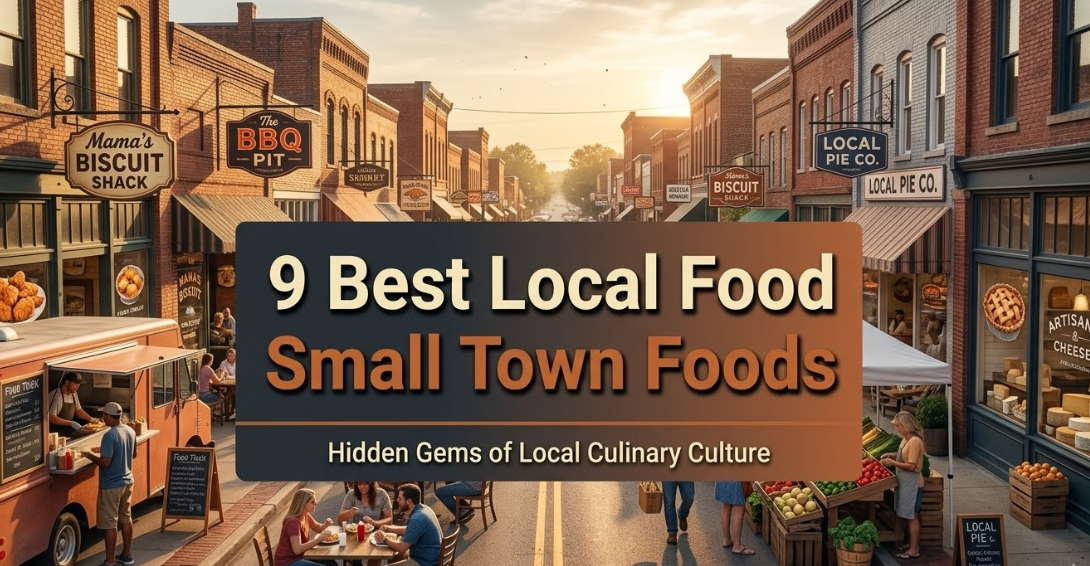
Discover the 9 ultimate local food small town discoveries you must try in this guide. Whether you’re plotting a road trip, mapping out a weekend getaway, or simply dreaming about your next big bite — each of these will give you some serious leads. For even more hidden culinary gems across America, Small Town Discoveries is one of the best resources to explore before you hit the road.
Why Small Town Food Culture Matters — The TL;DR Version
🏘️
87%
of local diners in the U.S. avoid chains when eating out
🥧
3x
more likely to come back when they find the good local food
🌾
62%
of small town restaurants locally source ingredients
📸
4.1B
#foodtravel posts on social media in 2024
1. The Roadside Pie Stand That Changed Everything
Discovery #1
Fruit Pies from Local Orchards — Hand-Baked
Imagine a wooden stand at the side of a country road. An old lady sells hand-crimped pies from fruit grown in the orchard behind her home. Each and every pie is different because each and every harvest is different.
This is as classic local food small town as it gets. Roadside pie stands live on in places like Door County, Wis., and along Route 11 in Virginia’s Shenandoah Valley.
What’s so special about these pies? A few things stand out:
- They pick the fruit at peak ripeness — not ship it unripe from a warehouse.
- The crusts are made with real lard or local butter, not shortening.
- The recipes have remained unchanged for 40 or 50 years.
Pro Tip: Show up early. These pies are sold out before noon. Seriously.
The flavors are entirely seasonal. In summer, peach and cherry. Autumn brings apple, pear, and quince. If you’re lucky, someone will have a rhubarb-strawberry special for two weeks.
These aren’t just desserts. They’re edible history. Every bite tells you something about the land that produced the fruit and the hands that baked it.
2. The Diner That Dates to 1952
Old-School Diners Serving the Real Thing
Not all diners are the same. Big city diners have style. Small town diners have soul. When a place has been offering the same breakfast since the Korean War, it has had decades to get it just right.
These places generally sit on the main street of a town with a population under 10,000. The coffee is served in a ceramic mug. The hash browns cook on a flat-top grill seasoned by a million breakfasts. And the regulars know their server by name.
What food travelers adore about small town diners
Authentic recipes
90%
Friendly service
83%
Low prices
76%
Local ingredients
65%
Historical character
58%
Seek out where the menu is laminated and a little sticky. Where the pie is covered with glass on the countertop. Where no one takes your order on an app.
What to order: The daily special. It’s always the best thing on the menu and it incorporates whatever the cook ran out to grab fresh that morning.
3. Farmhouse Cheese You Can’t Buy Anywhere Else
Artisan Dairy Treasures Hidden in Plain Sight
Small town cheese bears no resemblance to the stuff wrapped in plastic at the grocery store. In towns such as Mineral Point, Wis., and Grafton, Vt., tiny cheesemakers are creating something wonderful from locally produced milk.
The difference is in the flavor. When cows graze on local grasses, their milk takes on the character of the land. Cheesemakers refer to this as “terroir” — the same term winemakers employ. You’re tasting the place, not simply the product.
| Cheese Type | Best Small Town Region | Flavor Notes | Best Paired With |
|---|---|---|---|
| Sharp Cheddar | Central Vermont | Tangy, nutty, rich | Apple cider, crackers |
| Fresh Chèvre | Hill Country, Texas | Mild, creamy, citrusy | Local honey, sourdough |
| Aged Gouda | Lancaster County, PA | Caramel, butterscotch | Dark beer, charcuterie |
| Colby | Colby, Wisconsin | Mild, slightly sweet | Homemade bread, pickles |
| Smoked Farmer’s Cheese | Amish Country, Ohio | Smoky, dense, savory | Corn bread, apple butter |
Most of these farms sell directly from their property. Some allow you to observe the cheesemaking process. Some have been doing it the same way since their great-grandparents first came to this country.
When you discover a cheese you love in a small town, buy twice as much as you think you’ll need. There’s no shipping. There’s no website. It’s just that farm and that milk, at that moment.
4. BBQ Pits Handed Down Through Three Generations
The Smoke Knows No Shortcuts
Real BBQ doesn’t come from a gas oven. It emanates from a pit that has been burning since before the sun rose. And in small towns of the American South, the best BBQ places often don’t even have a sign — just smoke billowing up above the trees and a line of pickup trucks parked out front.
These places are elemental to local food small town culture. The pitmaster was trained by their own parent. Their grandparent taught their parent. The wood, the rub, the timing, the sauce — it’s all muscle memory and family pride.
Discovery #4
What Makes Generational BBQ Different
- Wood taken from the very property the family has owned for generations.
- Dry rubs made from spice blends no one records.
- Hours, not minutes, of smoke time — typically 12 to 18 hours for brisket.
- Sauce recipes that have not changed since the 1960s.
Some of the most legendary barbecue in the country comes from places such as Lexington, North Carolina; Lockhart, Texas; and Owensboro, Kentucky. These aren’t big cities. They’re close-knit communities where BBQ is culture, not just cuisine.
Go on a weekday if you can. The lines are shorter. The food is just as good. And you have a better chance of getting into a real conversation with the pitmaster.
5. Weekly Community Fish Fries
Friday Nights Were Made for This
In the lake towns of the Upper Midwest — Wisconsin, Minnesota, and Michigan — the Friday fish fry is a beloved weekly ritual. It includes churches, fire stations, VFW halls, and local restaurants.
For a couple of bucks, you are served a plate heaped with beer-battered perch, walleye, or lake trout. Cole slaw on the side. A dinner roll. A slice of rye bread now and again. Coffee that had been stewing on a burner since 4 p.m.
This is local food small town dining at its most communal. Everyone in town shows up. You will find yourself sitting next to families you don’t know, and end up talking about dessert before the night’s over.
Why it’s great: The fish is perpetually fresh from local waters. The batter recipe is typically the same one Grandma Helen scrawled on an index card in 1967. And the price hasn’t changed all that much since then, either.
When visiting a small lake town on a Friday, check local Facebook groups or community boards. These gatherings may not always be publicized online. But the locals will always tell you where to go.
6. Farm Stands With Produce You Cannot Name — and Must Try
Vegetables That Never Made It to a Supermarket
Big grocery chains carry what ships well and looks good after a thousand miles in a refrigerator truck. Farm stands operate on an entirely different system: what grew this week, right here.
That means you will encounter things you have never seen before. Purple carrots. Dragon tongue beans. Lemon cucumbers that are shaped like, well, lemons. Fourteen kinds of tomato you didn’t know existed.
| Season | What to Look For | Where to Find It |
|---|---|---|
| Spring | Ramps, fiddleheads, early strawberries, pea shoots | Appalachian foothills, New England |
| Summer | Heirloom tomatoes, sweet corn, stone fruit, herbs | Midwest, Mid-Atlantic, Pacific Northwest |
| Fall | Winter squash, apples, late peppers, root vegetables | Vermont, upstate New York, Colorado |
| Winter | Storage crops, greenhouse greens, preserved goods | Southern states, California coast |
The farmers at these stands welcome questions. Ask what’s best this week. Ask how they cook it at home. Nine times out of ten, you walk away with a recipe scrawled on the back of a paper bag and produce you’ll think about for years.
7. The Tamale Lady, the Pierogi Lady, and the Dumpling Grandma
Home Cooks Who Became Local Icons
Every small town with a robust immigrant or ethnic past has at least one. Someone who started cooking meals at home for family. Then for neighbors. Then for the whole town.
In small towns across Texas and New Mexico, it’s the tamale lady. She produces two or three hundred a week from scratch — masa ground just right, filling seasoned to a family standard no cookbook can capture. You call her, you pick them up, and that’s the whole transaction.
In Pittsburgh’s surrounding towns or the Polish communities of Northeastern Pennsylvania, it’s the pierogi lady. Thin sheets of dough stuffed with potato and cheese or sauerkraut and mushroom, boiled and buttered.
Discovery #7
How to Find These Unheralded Food Heroes
You won’t find them on Yelp. Ask at the local diner, the hardware store, the post office. Say you’re in the mood for good homemade food. Someone will know who to call.
These home cooks represent one of the most genuine forms of local food small town culture. Their food carries immigration stories, survival stories, and love stories all rolled into dough.
When you do find them, respect their time. Place your order in advance. Show up when you say you will. And always purchase more than you planned to.
8. Honey From Bees That Never Left the County
The Local Sweetness You Can’t Get at Any Airport Gift Shop
Mass-produced honey is filtered, blended, and heated until it’s basically just sweet syrup. Local honey from a small town beekeeper is another thing altogether. The color, flavor, and texture all change depending on what flowers the bees visited.
Clover honey from a Nebraska farm is pale and mild. Sourwood honey from the mountains of North Carolina has a spicy, anise-like finish. Tupelo honey from the Florida panhandle is buttery and thick. Orange blossom honey from Central California is scented precisely as its name implies.
According to Healthline’s overview of raw honey, raw local honey retains natural enzymes, antioxidants, and pollen that are stripped out during commercial processing — making the small town version not just tastier, but nutritionally richer too.
Flavor profiles of regional small town honey
Sourwood (NC)
Spicy
Tupelo (FL)
Buttery
Orange Blossom
Floral
Wildflower
Complex
Clover
Mild
Raw honey from a small town beekeeper also contains local pollen, which some people believe helps lessen seasonal allergies. Whether or not that’s true for you, the flavor by itself is worth every penny.
Buy it at the farm stand or straight from the beekeeper. It keeps well. Very few things make better souvenirs from a small town food trip than a jar of local honey.
9. The Secret Sauce, Pickle, or Preserve That Has a Cult Following
Condiments That Launch Wars (the Friendly Kind)
Every small town has at least one condiment that its residents will defend to the death. A backyard hot sauce made from peppers grown in someone’s garden. A pickle recipe so good, people three states away have asked for it. A fruit preserve that gets mailed as Christmas gifts to relatives who moved to the city 20 years ago.
These products hardly ever leave the county. They sell at the local hardware store, the diner counter, or out of someone’s car at the Saturday market. You find them by accident. You fall in love immediately.
Discovery #9
Famous Small Town Condiment Legends
- Wickles Pickles — founded in Dadeville, Alabama. Sweet, spicy, and unlike anything else in the jar aisle.
- Crystal Hot Sauce — originated in New Orleans, but its culture flows through Louisiana’s small towns where it goes on everything from eggs to red beans.
- Moonshine pepper jelly — appears at small-town festivals all over Appalachia with zero regularity and maximum deliciousness.
The secret to finding these is simply stopping. Stop at every roadside stand. Pull over at the hand-painted sign. Pause when something delicious is wafting in from an open window.
The best local food small town finds happen when you slow down enough to notice them.
All 9 Discoveries at a Glance
| # | Discovery | Best Time to Find It | What to Take Home |
|---|---|---|---|
| 1 | Roadside pie stand | Summer & Fall | Two pies minimum |
| 2 | Old-school diner | Any time | The daily special recipe (if they’ll share) |
| 3 | Farmhouse cheese | Year-round | A wedge of their aged best-seller |
| 4 | Generational BBQ | Weekends | Extra sauce in a jar |
| 5 | Community fish fry | Friday evenings | The memory |
| 6 | Farm stands | June–October | Strange vegetables you’ve never tried |
| 7 | Home cook icons | Call ahead | A dozen extra tamales / pierogies |
| 8 | Local honey | Late summer harvest | Two or three different varietals |
| 9 | Secret condiments | Farmer’s markets | Every jar they’ll sell you |
How to Plan a Delicious Small Town Food Trip
Step 1 — Choose a Region, Not a Restaurant
Don’t try to find specific restaurants first. Begin by selecting a region with a food tradition. The BBQ belt. Apple country in New England. The dairy heartland of Wisconsin. From there, the food will find you.
Step 2 — Drive the Back Roads
Highways connect cities. Back roads connect kitchens. Get off the interstate. Take the county road. Stop when something looks interesting. That’s where the real local food small town discoveries happen.
Step 3 — Talk to People
Ask your motel owner where they eat. Ask the gas-station attendant what the best thing in town is. Ask the person at the farm stand what they’re proud of making this week. People in small towns love to share their food culture with someone who is genuinely interested.
Step 4 — Eat Outside Your Comfort Zone
If you’ve never had sorghum syrup on a biscuit, try it. If someone hands you a pickled watermelon rind, eat it. If the special is something you’ve never heard of, that’s likely part of why you should order it.
Packing tip: Carry a small cooler in your car. Many of the best foods you’ll find — cheese, jam, fresh produce, smoked meat — need to stay cool on the drive back.
Frequently Asked Questions
What is local food small town culture, anyway?
It’s all about the food traditions, recipes, and places that are specific to a certain small community. That includes family-run farms, home cooks, generational restaurants, and community events focused on food that’s grown and made locally.
How do I find good food in a small town I’ve never visited?
Skip the national review apps. Instead, look for local Facebook community groups, ask at your motel or B&B, stop by the local hardware store or post office, and just ask people where they eat. Locals are nearly always happy to share their favorites.
Is food commonly affordable in small towns like these?
Most of the time, yes. Farm stands, community fish fries, roadside stands, and home cooks don’t generally charge anywhere near city restaurant prices. You’ll almost always get incredible value — in quality, flavor, and experience.
When is the best time of year to take a small town food trip?
The late summer to early fall period (August to October) is usually the peak for farm produce, fruit, and harvest-based food traditions. But every season has something to give. BBQ runs year-round. Fish fries happen every Friday. Cheese and honey are available whenever the farm is open.
Will these places have vegetarian or vegan options?
Absolutely. Farm stands, artisan cheese shops, honey producers, and fruit-based treats are all naturally friendly to vegetarians. Farm produce and fruit pies (check the crust ingredients) are your best bets if you’re vegan. It never hurts to ask — small-town cooks are often very accommodating.
How do I take local small town food back home?
A small cooler makes a big difference. Hard cheeses, cured meats, jams, pickles, and honey all travel well. For fragile things like fresh pies or delicate produce, pack them carefully and plan to enjoy them within a day or two of the trip.
Is this kind of food experience good for families with children?
They are among the best family experiences out there. Farm stands help kids understand where food comes from. Fish fries are informal and welcoming. Pie stands and honey farms are naturally exciting for little kids. Small town food culture is almost always warm, unhurried, and genuinely family-friendly.
The Dinner You’ll Never Forget Is Sitting on a Dirt Road
Big cities have great restaurants. Nobody’s arguing that. But the food experiences that you remember for a lifetime — the ones you tell stories about, the ones that change how you think about eating — those are most often found somewhere small.
A pie fresh from the oven. A pitmaster who will shake your hand, and means it. A cheese you’ve never had that tastes like nowhere else on earth. A jar of hot sauce with no barcode, no logo, and absolutely no equal.
These are the stuff of local food small town discoveries. You don’t need a reservation. You don’t need a five-star rating. You just need to slow down, look around, and trust the hand-painted sign by the road.
The unforgettable meal already exists somewhere out there. Go find it.