
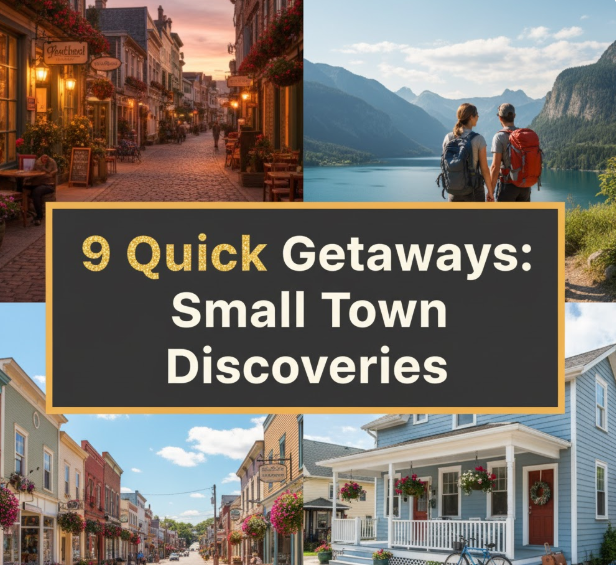
You don’t need two weeks’ vacation and a plane ticket to feel as though you’ve actually gone somewhere.
All it sometimes takes is a two-hour drive, a bag packed Friday night, and an openness to visit the sort of town you wouldn’t typically think of visiting.
Weekend escapes to small towns are having a serious moment — and with good reason. They’re affordable. They’re close. And they provide the kinds of experiences that major tourist destinations charge a premium to counterfeit.
This guide provides 9 easy small town discoveries that are perfect for weekend getaways. All are easy to find, low-cost or free, and the kind of memory that lingers long after the end of a weekend.
Be you planning your first short escape or your fifteenth, there’s something for every sort of traveler here.
Let’s go.
Why Weekend Getaways to Small Towns Feel Different
Long vacations are great. But they involve planning and saving, not to mention time off that not everyone has.
All that gets fixed on weekend trips to small towns.
Leave on Saturday morning, back Sunday night. You do not have to make a hotel reservation months in advance. You won’t have to choke your way through airport security or sit in a two-hour traffic jam entering a major city.
What you do get is the real deal: fresh air, slower pace, local food, and conversations with people who actually live in the places you’re visiting.
The numbers back this up too. Surveys consistently show weekend travelers are more satisfied when they visit a small, non-commercialized destination instead of a major tourist city. The answer is simple — less noise, more substance.
And the best part? Most of us drive right past these towns every single week, not knowing what is inside them.
Discovery #1 — The Saturday Morning Farmers Market
When you pull into a small town on Saturday morning and there’s a farmers market in full swing, everything else can wait.
These aren’t the gleaming, brand-centric markets of cities. Markets in small towns are raw and real. Local farmers have simple tables. A retired teacher sells jars of homemade fig jam. Someone’s teenage kid is selling hand-thrown pottery for the first time.
Show Up Early — It Matters
The best stuff disappears fast.
Fresh loaves of sourdough, pastured eggs, seasonal berries, raw honey in small jars — if you show up at 11 AM, you’re getting the run-off. Arrive by 8 or 9 and the full spread remains.
Talk to the vendors. Inquire as to what they grew this season. If you’re not sure what to ask, ask them which item they’re most proud of. Engaging in these conversations is quick, simple, and can be a highlight of an entire trip.
Markets also give you the 30-minute pulse of a town. You find out who’s growing what, what the local obsessions are, and which other places are worth a visit. Every vendor in the market is an unofficial tourism guide.
What to Budget
Most small-town market goods come at a fraction of what you’d pay at a specialty grocery store. Expect to spend $20–$40 and return home with more than you bargained for. Carry cash — many vendors do not carry card readers.
Discovery #2 — A Stroll Down the Old Main Street
There is a main street in every small town. Not every traveler bothers to take a slow walk along all of it.
That’s a mistake.
Old main streets in small towns are walking museums. The buildings tell you when the town was founded, what industry kept it bustling, and which eras left their imprint. You can read the economic history of a place just by peering at the storefronts.
What to Actually Look At
Remember to look up — not only at eye level.
Old main street buildings have the original architecture on the upper floors. Cornices, brickwork, painted ghost signs from businesses that closed 50 years ago. The upstairs is where almost all tourists never venture.
Check the dates chiseled into building facades. Look for the oldest building on the block and imagine what was going on in the world when it was constructed.
Dip into the shops that are open. Not to buy necessarily — just to observe what a town chooses to keep alive. A town that has a functioning hardware store, a local pharmacy, and an independent diner is a healthy town. A main street lined with antique shops and not much else suggests a different kind of narrative.
The Ghost Signs Worth Finding
In many small towns, the painted advertisements on brick walls have faded — signs for tobacco, medicine, or dry goods that haven’t been repainted in a century.
These “ghost signs” are a goldmine for small town photographers. They’re also a direct window into commercial life from 80 to 120 years ago.
Discovery #3 — The Local Diner or Lunch Counter
The diner is a topic most of you are familiar with. But the lunch counter version merits its own spotlight.
In some small towns, lunch counters still operate inside old pharmacies, hardware stores, or five-and-dime shops. These are not restaurants in the usual way. They’re eight stools, a griddle, and a person who has been making the same grilled cheese sandwich since the Reagan administration.
Why These Places Are Disappearing
Lunch counters are an endangered species.
The overhead is low — as is the volume. A family-run lunch spot may close, but it rarely reopens as something similar. It turns into a cell phone repair store or a nail salon — both fine, but not the same.
A working lunch counter in a small town feels like discovering something that should already be gone. Order whatever’s on the board. Sit at the counter. Don’t check your phone.
The Diner Rule That Always Works
Here’s a rule that applies almost anywhere: if a diner’s parking lot is filled with work trucks at 7 AM on a weekday, the food is good.
Weekend warriors don’t drive those trucks. These are residents who eat there because it’s worth it, not because it’s convenient.
Use this logic during your Saturday morning search and you will not go wrong.
Discovery #4 — The Nature Trail No One Drew on a Map
Small towns beside forests, rivers, hills, or farmland usually have at least one path that only locals know about.
It lacks a trailhead sign. You won’t find it on any hiking app. It’s simply a route locals take because they always have.
How to Actually Find It
First stop is the diner (see Discovery #3). Sit at the counter and ask: “Is there a good walk nearby that most visitors don’t know about?”
That phrasing is important. If you ask for “a good hike,” you may be sent to whatever is officially listed. Ask for something most visitors don’t know about, and the reply shifts completely.
Local hardware stores and small-town pharmacies are great sources as well. The folks who work there have lived in the town for decades and know every route, creek crossing, and viewpoint.
What You Tend to Find
Off-map trails tend to lead to truly spectacular places — old swimming holes, ridgeline views, creek-side clearings, or the ruins of old homesteads that never made it onto a tourist brochure.
The point is the absence of infrastructure. No parking lot means no tour buses. No interpretive board means you are left to use your imagination. The absence of a guardrail means you are trusted to be cautious.
These are the outdoor experiences that feel earned, not packaged.
Discovery #5 — The Nearly Free Town Museum
Small-town museums are chronically undervisited and fiercely underrated.
They are often free or request a modest suggested donation. They are run by volunteers who know every single object in the building personally. And they contain stories that didn’t make it into any textbook.
For more small town travel inspiration like this, visit Small Town Discoveries — a dedicated resource for off-the-beaten-path weekend getaways.
What Makes Them Worth One Hour of Your Time
Museums in large cities are arranged for thousands of daily visitors. Everything is behind glass, labeled, and explained from afar.
Small-town museums are intimate. You can ask questions. The docent will pull out an unlabeled photo and tell you exactly who appears in it and what became of them. You may find yourself actually holding a 150-year-old tool and being told how it was used.
Local museums also have a habit of hiding the unexpected.
You’ll learn that a small town used to be a booming railroad center. You’ll discover that a person you’ve never heard of invented something you use all the time. And you’ll learn about a flood, a fire, or a wave of migration that swept through and remade a community — and that none of the people affected ever became famous for having survived it.
The Volunteer Effect
The people running these museums aren’t professional historians. They’re retired teachers, grandchildren of founding families, and lifelong residents who volunteered because the stories meant something to them personally.
You can hear that passion in every conversation. Ask them what their favorite piece in the collection is. The answer will be specific, surprising, and worth every single second.
Discovery #6 — The Craft Brewery or Cidery Off a Side Street
You will not find it on the main road. It will be in an old warehouse, a converted grain building, or a repurposed garage down the side street you nearly missed.
That’s where the good craft brewery is hiding.
Why Side-Street Spots Are Better
Even the main street craft spots in small towns are often aimed at tourists. The proper breweries — the ones locals actually drink at — are off the beaten path.
They have lower overhead, simpler menus, and no desire whatsoever to perform for Instagram. The person behind the bar usually made what’s in your glass. Ask them about it and they will happily talk for twenty minutes.
Seek out places with a tiny outdoor area that appears to have been built by someone on a weekend. Mismatched chairs. String lights, some of which may or may not all be working. A handwritten specials board.
That’s the one.
What to Order
Always ask what the seasonal release is, and whether they have anything with a local ingredient.
Small-town breweries that draw from the land — hops from a nearby farm, apples from an orchard down the road, honey from a beekeeper you met at the Saturday market — are creating something you truly cannot find anywhere else.
It is this uniqueness that makes for an ideal weekend away. You arrived in search of something that can’t be duplicated at home. A pint of that local stout or orchard cider is exactly that.
Discovery #7 — The Quirky Independent Bookshop
Not every small town has one. But when it does, it tends to be extraordinary.
Independent bookshops in small towns survive because owners are passionate about the notion that a community needs a space for books. These are not people who got into bookselling for the money. They became booksellers because it mattered.
The Curation Is the Magic
Small-town indie bookshops don’t stock everything. They stock what the owner loves, what local residents ask for, and what they genuinely feel people ought to be reading.
That curation is what makes every shelf a recommendation. The mystery section is not 300 thrillers listed in alphabetical order — it’s 40 books that someone loves, laid out as a reflection of their reading life.
Look for handwritten notes on the shelves. “Staff pick” cards at an indie bookshop tend to be more interesting than anything on a bestseller list. They’re personal, particular, and sometimes brilliant.
What to Buy That You Won’t Find Anywhere Else
Many small-town bookshops carry:
- Books by local authors you’ve never heard of
- Regional history collections not available on Amazon
- Literary fiction published by small presses that never saw mainstream distribution
- Out-of-print titles the owner tracked down specifically
Factor in an extra 45 minutes and a bit of additional luggage space. You’ll use both.
Discovery #8 — The Town Festival You Didn’t Know Was Happening
This one takes some luck — or a bit of foresight.
Small towns have festivals that most anyone outside of a 30-mile radius will never know about. No national press coverage. No influencer campaigns. Just a town doing something they’ve been doing for decades because it’s theirs.
The Types of Festivals That Alter Your Weekend
Agricultural towns hold harvest celebrations in late summer and early fall. They include food, music, and a sense of community pride that you can feel in the air.
Heritage festivals commemorate the ethnic or cultural background of a town’s founding families. These are windows into cultural traditions that have been maintained through true community effort, rather than tourism programming.
Art walks and studio tours take place in small towns with vibrant creative communities. Local artists open their studios for a weekend. You stroll from building to building, chat with the makers, check out works in progress, and purchase directly from the person who produced it.
How to Stay Informed About What’s Going On
Before visiting, consult the town’s chamber of commerce website. It’s generally outdated and hard to navigate, but somewhere in there is a calendar. Even finding one event makes it well worth the 10 minutes spent searching.
Or just ask when you get there. “Any events in town this weekend?” is a question that is always answered enthusiastically.
Discovery #9 — The Sunset Overlook Nobody Tags
It’s the sort of place every small town near any kind of elevation — a ridge, a water tower hill, a bridge over a river valley — has: a sunset spot that locals know and visitors stroll straight past.
This is the last easy weekend small town discovery on this list — and maybe the most significant.
Why the View Matters
After a full day of markets, diners, trails, museums, and bookshops, you need a place to simply stand still.
That place is the sunset overlook.
It costs nothing. It requires no reservation. It doesn’t close at 5 PM. You drive up or walk up, sit down, and watch the light change on a landscape that most of the people in the world will never see.
That’s the silent miracle of small town travel. The highlight of your whole weekend might be 20 minutes of silence on a nameless hillside without signs or reviews on any app.
Finding It Before Sundown
Stop into any local business in the afternoon and ask: “Where’s the best place to watch the sunset around here?”
You will receive an answer that is precise and immediate. Nobody hedges on this question. Everyone knows.
Weekend Trip Planning Made Simple
Here is a simple blueprint for assembling a two-day small town escape around these nine discoveries:
| Time | Activity | Discovery |
|---|---|---|
| Saturday 8 AM | Arrive, hit the farmers market | #1 |
| Saturday 10 AM | Walk the old main street | #2 |
| Saturday noon | Lunch at the diner or counter | #3 |
| Saturday 2 PM | Off-map nature trail | #4 |
| Saturday 4 PM | Town museum | #5 |
| Saturday evening | Craft brewery or cidery | #6 |
| Sunday morning | Indie bookshop | #7 |
| Sunday afternoon | Town festival (if running) | #8 |
| Sunday 7 PM | Sunset overlook before heading home | #9 |
This itinerary is workable in just about any small town two to three hours from where you live. No advance booking is needed for most activities. For two people excluding accommodation, the total bill is usually less than $150.
The Difference Between a Small Town Weekend and a Big City Weekend
| Factor | Small Town Weekend | Big City Weekend |
|---|---|---|
| Average daily cost | $60–$100 per person | $150–$300+ per person |
| Time waiting in lines | Less than 30 minutes total | Often 2+ hours per day |
| Conversations with locals | Many, organic | Rare, transactional |
| Unique experiences | High — hard to replicate | Moderate — widely shared |
| Advance planning required | Minimal | Usually significant |
| Feeling when you get home | Rested, recharged | Often exhausted |
FAQs About Easy Weekend Small Town Getaways
Q: How far should I travel for a small town weekend trip?
The ideal range is 1.5 to 3 hours from home. Close enough that you’re not spending your whole Saturday in the car, but far enough to feel like you’ve actually gone somewhere. Towns at the very edge of that range often feel the most rewarding, because the change of scenery is so significant.
Q: Should I reserve accommodation months in advance?
Usually not. Outside of big local festival weekends, small town guesthouses and B&Bs seldom sell out weeks in advance. A week ahead is often enough. Some local guesthouses don’t list on the big booking sites — search for the town name plus “guesthouse” or “B&B” directly and look at their own websites.
Q: What if I get there and the town feels like there’s nothing to do?
Walk in and ask a local. Seriously — this is nearly always a winner. Go into the first open business you encounter, say you’re a visitor, and ask what they would recommend. People in small towns are generally friendly and very proud of their community.
Q: How can I discover small towns worth visiting near me?
Start with a map and look for towns of between 5,000 and 20,000 residents within your travel radius. Seek out towns close to rivers, mountains, or forests — natural features tend to provide more options for outdoor activities. Look for towns with a “historic district” or active chamber of commerce — those signals typically mean a preserved main street and a community that takes pride in its identity. The American Battlefield Trust’s guide to historically significant small towns is also a great starting point for finding towns with deep roots and stories worth discovering.
Q: Are these weekend discoveries kid-friendly for families with children?
Most of them, yes. Farmers markets, main street strolls, nature trails, local museums, and sunset overlooks are all family-friendly. For families, the artisan market is a particularly good choice — children are naturally curious about where food comes from, and talking with vendors is a simple and engaging experience for all ages.
Q: What is the one thing you must do on a small town weekend trip?
Put your phone down and speak to people. Every other discovery on this list is best experienced with real local conversation. The trail tip comes out of a conversation. The best thing on the menu starts with asking. The hidden overlook comes from someone who has watched the sunset there a hundred times. None of that information exists on the internet — it exists in the people.
Q: Is there a best time of year for small town weekend trips?
Every season has its strengths. Autumn provides harvest festivals and foliage. Spring brings farmers market season springing up and the countryside bursting into bloom. Summer delivers the longest days and greatest outdoor activity. Winter visits to small towns are quiet and uncrowded, with a stillness that’s hard to find at any other time of the year — particularly if there’s a working fireplace at a local diner.
Q: What should I always pack for a small town weekend?
Cash (many local vendors and small businesses prefer it), a reusable bag for market purchases, comfortable walking shoes, a lightweight daypack for time on the trail, and no fixed itinerary past the first hour. The looser your plans, the better your weekend tends to go.