
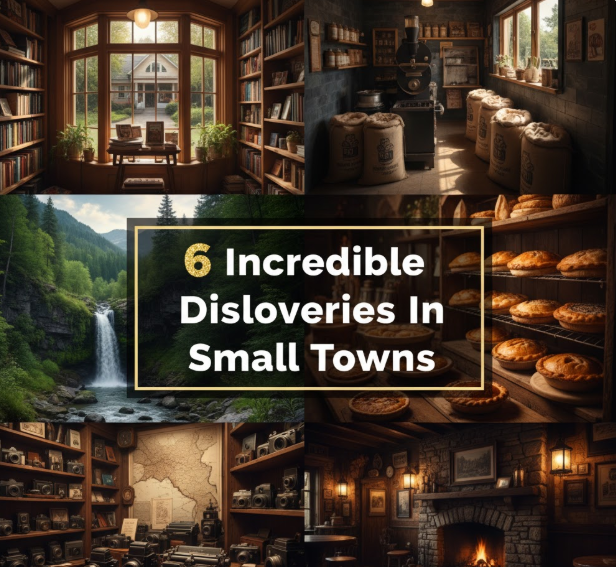
You don’t need a passport or an itinerary full of activities to make a trip memorable.
(Especially in a place without even a traffic light, but apparently everything else you didn’t know you were searching for.)
Small town discoveries on a weekend sneak up on you. You veer off the main road in search of a restroom, and suddenly you’ve found yourself standing before a 150-year-old covered bridge. You pause for coffee and end up chatting with a baker whose grandmother created the recipe in 1943.
These are the moments that you can’t program on a tour app. They cannot be manufactured in a resort. They simply happen — in small towns.
In this article you will find six textural discoveries that await on weekend adventures to small towns across America. All are readily available, free or very cheap and well worth your Saturday.
Why a Small Town Weekend Is Better Than a Big City Getaway
Before we get started, let’s discuss why small towns are having a moment.
Travel fatigue is real. Luxury hotels, packed airports, destructive tourist traps — many people are burned out on the traditional type of vacation. What they are looking for is authentic. Something slower. Something that costs less than $300 before breakfast.
That’s precisely what weekend small town discoveries provide.
A 2024 survey by the American Road Trip Association reported that nearly 80 percent of travelers who took a small town weekend getaway said it was “more memorable” than a similar trip to an urban destination — and more than half spent less than $150 on the entire journey.
You always see why the numbers add up when you think. Small towns are cheaper, less rushed and more generous. Here’s a quick breakdown:
| Travel Style | Avg. Weekend Cost | Crowd Level | Unique Experiences |
|---|---|---|---|
| Major City Tourism | $350–$700 | Very High | Moderate |
| Beach Resort | $400–$900 | High | Low |
| Theme Park | $300–$600 | Very High | Low |
| Small Town Weekend | $50–$150 | Very Low | Very High |
The case basically makes itself.
Now, here are the six discoveries that can turn a small town weekend into one you will be talking about for years.
Discovery No. 1 — The Saturday Farmers Market That Feels Like a Block Party
Not Just Vegetables — But the Whole Town in One Place
When many people consider a farmers market, they picture buying tomatoes.
In a small town, it’s so much more than that.
Small town farmers markets are the social highlight of the week. Every player from the area comes — from the woman who sells ceramic mugs in a tent next to one who sells elderberry jam in another tent next to an old farmer who grows six kinds of heritage corn. In the corner, there’s a bluegrass band playing. Children run between the tents. The air is thick with the scent of fresh-baked bread.
You walk through it as if you’re turning the pages of a living, breathing community.
What You’ll Really Find at a Small Town Market
It’s hard to believe what you see at a truly local market until you do. Here’s a taste of what is generally available:
- Fresh seasonal produce cultivated within a few miles
- Hand-thrown pottery and woodworking
- Fresh-cut flowers and herbs
- Homemade preserves, pickles, and sauces
- Honey and beeswax candles raised by local people
- Handmade soaps and natural skincare
- Pastries — pies, breads, scones, sticky buns
- Jamborees, often unplugged and acoustic
The prices are literally always shockingly low. Wild blackberry jam in a whole jar for $6. A hand-thrown mug for $12. A loaf of sourdough for $5.
And the conversations are free.
If you ask any vendor about their product, you will get a story. The woman selling lavender honey will tell you she has 200 hives. The man with the garlic braids will tell you why his family has grown this same variety since 1962.
Finds like this, tucked into the weekend small town discoveries category, rarely land on a sponsored travel schedule — and are often the best parts of an entire trip.
Discovery No. 2 — The Covered Bridge That Has Stood for 150 Years
Wooden, Weather-Beaten and Holding Up
There’s something quietly amazing about a covered bridge.
It was built in the 1800s. By hand. With tools that would seem primitive by our standards today. And it remains — still supporting cars, still lining a creek, still perfectly postcard-worthy.
There were once more than 10,000 covered wooden bridges in America. Today, roughly 800 remain. Most are in small towns, tucked away at the ends of country roads, known only to local residents and the occasional passerby who discovers them.
Why They Were Covered in the First Place
Many people assume covered bridges were built to shield travelers from rain. That is not actually the real reason.
The roof and walls were added to protect the wooden deck from weather. Exposed wood rots quickly. Covered wood has the potential of lasting for centuries. The engineering logic was both simple and brilliant — and it worked.
What makes this especially remarkable is that so many surviving covered bridges remain in operation today. They were made before the Civil War, and cars still drive over them day after day.
Where to Find Them
Some of the best covered bridge destinations in the US are:
| Location | Number of Bridges | Best Season to Visit |
|---|---|---|
| Parke County, Indiana | 31 | Fall (October festival) |
| Lancaster County, Pennsylvania | 28 | Spring and Fall |
| Ashtabula County, Ohio | 19 | Year-round |
| Windsor County, Vermont | 9 | Fall foliage season |
| Covered Bridge Scenic Byway, Oregon | 6 | Summer and Fall |
Each has its own name, its own history and its own story. Some are painted red. Some are natural gray wood. Some span wide rivers. Some cross gentle brooks you could hop over.
Each will make you pause, get out of the car and stand there quietly for a moment.
That’s something rare in modern life — and these weekend small town discoveries have a knack for making those moments happen.
Discovery No. 3 — The Antique District That Feels Like It Goes for Blocks
One Street, a Thousand Stories, No End to the Rabbit Hole
Some small towns have one antique shop. Others have an entire district.
These are the towns where three or four blocks of the main street have been taken over by dealers, pickers and collectors. Every storefront is packed. Every corner has a booth. Every shelf contains something you didn’t know you needed until the moment your eyes landed on it.
Why a Small Town Antique District Is Different
Antique stores in large cities are often well polished and expensive. A restored armoire for $2,400. A gallery wall set of vintage prints, framed and priced accordingly.
Antique districts in small towns are a beautiful mess — and a far better place to shop.
Here, the inventory mirrors real lives that have unfolded in the surrounding region. Farming tools from the 1920s. Depression-era glassware in every color. A box of antique postcards from towns you’ve never heard of. A functional rotary phone still connected to its original wall mount.
It is the prices that truly set them apart. What would be marked up three times in an urban antique mall is often priced at what the dealer paid, with only a small markup. For $15 you can walk away with a real piece of history.
The Thrill of the Hunt
The best thing about a small town antique district isn’t any one item. It’s the process.
You don’t know what you’re going to discover. You could pass by a bin of old keys and grab one with a tag that says “1887 — original key to the Hartwell Hotel.” You could discover a first edition of your favorite book wedged between a box of Reader’s Digests and an old Webster’s.
The unpredictability is part of the point.
Famous small town antique destinations in America include Adamstown, Pennsylvania (the Antiques Capital of the U.S.), Shipshewana, Indiana, and Hillsville, Virginia.
Weekend small town antique district discoveries are particularly good for anyone who enjoys history, design, or simply the joy of finding something special no one else was searching for.
Discovery No. 4 — The Local Festival You Accidentally Landed On
Pie Contests, Parade Floats and the Happiest Crowd You’ve Ever Seen
Here’s a situation that occurs more frequently than you might think.
You pull into a small town on Saturday morning, realizing you’re hungry. There are cars parked everywhere. Bunting is stretched between the lampposts. There’s a marching band warming up in the parking lot of a hardware store.
You have accidentally arrived on the very day of a festival.
What Small Town Festivals Do That You Won’t Find Elsewhere
Many big-city festivals can be expensive, crowded and corporate-sponsored. They’re designed for maximum profit. The food is mediocre. The lines are brutal. The experience is anonymous.
Small town festivals exist for a whole different set of reasons.
They commemorate the town’s history, its crops, its heritage or its oddities. There is a festival in Gilroy, California, devoted entirely to garlic. There’s one in Barnesville, Ohio that honors pumpkins. There is a festival for fall leaves, winter lights, spring blossoms, summer peaches and everything in between.
Here’s a comparison of small town festivals vs. big city events:
| Factor | Small Town Festival | Big City Event |
|---|---|---|
| Admission | Free or less than $10 | $30–$100+ |
| Crowd Density | Comfortable | Overwhelming |
| Food Quality | Homemade, local | Chain vendors |
| Community Atmosphere | Warm, welcoming | Impersonal |
| Unique Character | Very high | Moderate |
The vendors are local. The volunteers are neighbors. The entertainment is genuinely talented. And everyone is in that special kind of good mood you only get when an entire community has collectively decided to celebrate.
If you encounter one on your weekend outing, consider yourself fortunate.
Discovery No. 5 — A Historic Cemetery That’s Like a Novel
This Is One That May Surprise You — and That’s the Whole Point
This is a weekend small town discovery most people don’t expect to find on this list.
Historic cemeteries.
Hear us out.
One of the most profound and genuinely interesting ways to spend an afternoon is wandering through a well-preserved small town cemetery — preferably from the 18th or early 19th century. It’s completely free. It’s always quiet. And it’s packed with stories.
Making Time for Old Cemeteries
The headstones in an old graveyard are primary sources. They document names, dates, relationships — and in many cases, cause of death. They embody the tragedies and triumphs of real people who shaped the town you see around you.
Their arrangement makes you start noticing patterns.
One family lost all its children in one generation. An entire row of the same surname, all died within weeks of each other in 1847. A group of young men from the same town, buried the same year, bearing the same military rank. A grave marker for a child, with a lily and a lamb carved on top.
These stones tell the story of the town in a way that no museum exhibition quite does. You’re not reading about history. You’re standing in it.
What to Look For
- Epitaphs: Many 18th and 19th century gravestones had poetry, scripture or personal messages etched into the stone
- Stone styles: Older stones often have carved skulls, hourglasses or angels — all with symbolic significance
- Family plots: You can trace whole family histories simply by reading the stones in one section
- Veteran markers: Small flag markers and military emblems tell you who served and where
- The oldest stone: Every historic cemetery has one — and when you find it, it’s like a treasure hunt
Boston’s Old Granary Burying Ground is the best known, but even smaller and lesser-known historic cemeteries in rural towns can feel more intimate and personal.
Discovery No. 6 — The Family-Run Bakery That Is Older Than the Building Itself
Four Generations, One Cinnamon Roll, Zero Competition
Every great small town has it.
The bakery that’s been there forever. The one where the sign is hand-painted and slightly faded. Where the cases are stocked with things you know and things you’ve never seen. Where the person behind the counter is an owner, an owner’s spouse or an owner’s kid.
And where everything — everything — is prepared from scratch before sunrise.
What Sets a Family Bakery Apart From Every Other Bakery
There’s something very particular about food made by someone who has been making the same thing for 40 years. It’s not just skill. It’s certainty. Every measurement is instinct. Every timing is intuition.
The cinnamon rolls are great because they’ve been made the same way 10,000 times.
The coffee cake contains exactly the right amount of streusel, because that was the baker’s grandmother’s judgment back in 1956 — and over the decades, nobody dared contradict her.
All the best bakeries are community hubs. The regulars come in every morning. They sit in the same seats. They order the same things. They talk to the same people.
As a visitor, you get to show up to that rhythm for a morning — and it’s one of the warmest, most hospitable feelings a small town can provide.
Order (and Ask)
If you cross the threshold of a family bakery in a small town, resist the urge to reach for whatever is closest. Ask at the counter what their specialty is. Ask what’s been on the menu the longest. Ask whether there’s anything they make that no one else does.
The answers are always interesting. And the food is nearly always extraordinary.
Here are some legendary small town bakeries worth seeking out:
- The Danish Maid Bakery in Elk Horn, Iowa — home of authentic Scandinavian recipes for Danish pastries since 1960
- Blue Owl Bakery in Kimmswick, Missouri — known for a levee-high apple pie so tall it has its own name
- Sweetie-licious Bakery in DeWitt, Michigan — an award-winning vintage-inspired bakery that attracts visitors from around the state
Weekend small town discoveries don’t get much sweeter than this.
How to Plan a Perfect Weekend in a Small Town
You don’t need much. Here’s a basic framework that applies every time:
Step 1 — Choose a region, not a destination. Choose a fairly large area within two to three hours of home. Don’t overplan. Small towns reward wandering.
Step 2 — Check the weekend calendar. Just type “[county name] + festival + [month]” into a search engine and you’ll find out if anything is happening. The experience is magnified on a market or festival day.
Step 3 — Travel light and carry cash. Cash is preferred by most small town vendors. An envelope with $60–$80 in smaller bills goes a long way.
Step 4 — Eat local at every meal. Skip every chain. If the diner has been there since 1952, eat there. If a bakery opens at 6 a.m., set an alarm.
Step 5 — Talk to people. Ask the market vendor, the antique dealer, the bakery owner how long they’ve been here. Ask what they enjoy most about the town. The responses will be the highlight of your trip.
Frequently Asked Questions About Weekend Small Town Discoveries
Q: How far should I travel for a small town weekend trip?
The sweet spot is typically one to three hours from your home. Close enough to make the trip stress-free, far enough to feel like a proper getaway. You won’t need a hotel if you get an early start — most small town adventures are day-trip friendly.
Q: What if the town feels a little quiet or closed up?
That is actually a good sign that you are in the right spot. Poke around a bit. Walk a few blocks. Small towns are not in the business of advertising their best features — you have to seek them out. Look for a community bulletin board, usually located near the post office or town hall.
Q: Are small town weekend trips good for kids?
They are among the best trips you can take with kids. Farmers markets, antique hunting, covered bridges to walk across and community festivals all come with built-in wonder for children. They’re low-stress, low-screen and high-memory.
Q: What is the estimated cost of a weekend trip to a small town?
Most people spend between $50 and $150 for a full day or weekend, accounting for food, small purchases and any event admissions. A local bed and breakfast usually runs $90–$150 per night, sometimes including a homemade breakfast, if you are staying overnight.
Q: How can I discover small towns worth visiting?
The National Register of Historic Places, state tourism sites and road trip apps like Roadtrippers are good places to start. Local Facebook groups and Reddit travel threads often provide the most honest, current recommendations.
Q: What’s the best season for weekend trips to small towns?
Fall is generally considered the best. The weather is mild, the scenery is stunning, and many towns hold harvest festivals throughout September and October. Spring is a close second. Summer is great for drive-ins and outdoor markets. Winter has its own magic in towns that observe the holidays the old-fashioned way.
Conclusion: Your Best Weekend Is Nearer Than You Think
There’s a town just hours away from where you’re sitting now.
It has a farmers market on Saturday morning. It has an antique shop that has been passed down through three generations. It has a bakery where the coffee is strong and the rolls are fresh and nobody’s in a hurry.
It may have a covered bridge, a fairground, or a graveyard bursting with tales older than the nation itself.
These weekend small town discoveries are not hidden in the way that requires maps or secrets. They’re buried in the way quiet things are always buried — right under our noses, if only we could pause long enough to see.
So pick a direction. Fill the tank. Take an exit off the interstate that looks interesting.
Your most memorable weekend adventure of the year may begin with a left turn down an unfamiliar road.