
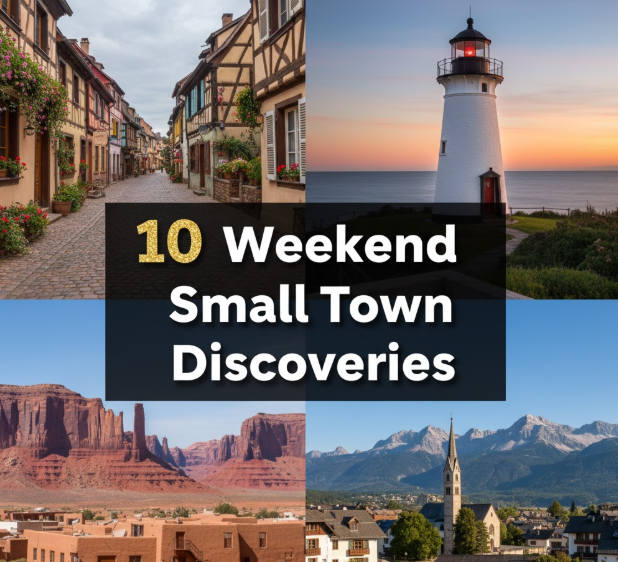
You’ve got two days. A full tank of gas. And no interest in another packed theme park or pricey urban hotel.
What you seek is something that feels authentic. A town with a pulse — where people meet at the same diner each morning, where local artists display their work in a converted barn and no one is rushing anywhere.
Weekend small town exploration is the very definition of that sort of travel. They are jaunts that make lasting impressions. No 14-hour flights. No passport required. Just a great playlist, an open road and a destination most people couldn’t name.
This guide includes 10 weekend-worthy small towns in the United States — each selected for its individual character, depth of experience and because it truly merits a two-day visit.
Why Weekend Small Town Road Trips Are So Gut-Punching
There is a pattern that occurs with small town travel.
You arrive with low expectations. You planned a quick overnight. But by midday, day one, you’re begging the innkeeper for a room on Sunday night as well.
Because small towns provide something unique: real discovery.
No two towns on this list feel alike. One is located on a cliff overlooking a river gorge. Another is an 18th-century hamlet frozen in time. Another is a quirky arts colony that became one of the country’s most photographed towns by accident.
These weekend small town discoveries work because they’re manageable. You can literally see a town in two days. Walk every street. Try every local restaurant. Leave feeling as if you know the place — not that you just passed through it.
✦ ✦ ✦
01
Jim Thorpe, Pennsylvania — The Switzerland of America
Population: 4,800Best Season: AutumnDrive from Philadelphia: 2 hours
Jim Thorpe should not be this good. It’s a former coal and railroad town nestled in the Pocono Mountains. Somehow, though, it ended up being one of the more visually spectacular small towns anywhere on the East Coast.
A Town Preserved at Peak Elegance
The Victorian architecture around here is stunning. Rich industrialists raised mansions on Broadway in the 1800s. Those mansions remain — ornate, immaculate and amazing to walk past.
The Asa Packer Mansion is the centerpiece. It perches on a hill above the whole town and has been preserved nearly in its 1878 state. The tours go room by room, and the craftsmanship inside is jaw-dropping.
The Lehigh Gorge
The Lehigh River slices through a deep gorge just below town. The Lehigh Gorge State Park features hiking and is home to one of Pennsylvania’s most beautiful rail trails. In the fall, the gorge becomes a wall of red, orange and gold.
In spring, when the water levels are high, white-water rafting on the Lehigh is popular. There are several outfitters in town.
Named After a Legend
Jim Thorpe, the Native American athlete who is regarded as one of the greatest athletes in history, is buried here. The town changed its name in his honor in 1954. His mausoleum lies on the outskirts of town — a modest, considerate tribute.
This is one of those weekend small town discoveries that completely blindsides you — and then has you wondering why you’ve never heard of it before.
02
Beaufort, South Carolina — Spanish Moss and a Deep History
Population: 13,000Best Season: SpringDrive from Savannah: 1 hour
One of the oldest towns in South Carolina, Beaufort (pronounced “BYOO-furt” by locals — take note) was founded on Port Royal Sound, bordered by tidal marshes and sea islands, and features some of the most striking antebellum architecture in the American South.
The Point Neighborhood
The Point is Beaufort’s historic district: a quiet peninsula that stretches into the river and on which enormous white-columned houses sit beneath canopies of live oaks dripping with Spanish moss.
Walking The Point feels cinematic. In fact, it has been. Movies including Forrest Gump, The Big Chill and The Prince of Tides were filmed here.
Gullah Geechee Culture
Beaufort is a major center of Gullah Geechee culture — the unique culture that developed among enslaved Africans and their descendants in the Sea Islands. Local museums, galleries and guided tours provide meaningful insights into this living, vibrant heritage.
The Penn Center, on nearby St. Helena Island — one of the first schools for freed enslaved people to open in the South — is a National Historic Landmark that’s worth a stop.
Waterfront Life
The downtown waterfront of Beaufort is lined with restaurants and shops. The area’s best activity is kayaking through its tidal creeks. At sunset, the Beaufort River turns shades of pink and gold that seem almost fictional.
This is a small town discovery with serious depth for a weekend. Two days is barely enough.
03
Telluride, Colorado — Closed in a Box Canyon, Just Right
Population: 2,500Best Season: Summer / WinterDrive from Montrose: 1.5 hours
Telluride sits at the bottom of a box canyon in the San Juan Mountains, 8,750 feet up. Three sides of the canyon walls reach more than 13,000 feet. There’s no way in or out other than the single canyon entrance — or by gondola to the Mountain Village above.
That geography gives rise to something rare: a town that literally cannot sprawl. The entire town of Telluride is walkable, historic and gorgeous.
The Free Gondola
One of the best aspects of Telluride is completely free. The Mountain Village Gondola, which operates year-round, links downtown Telluride to the Mountain Village above it. The views from the gondola cabin — looking back down into the canyon at the town — are incredible. Ride it at sunset. Bring a jacket.
Festivals That Fill the Canyon
Telluride has some of the best festivals in America. Held every Labor Day weekend, the Telluride Film Festival has launched Oscar-winning films. The Telluride Bluegrass Festival attracts musicians and fans from all over the globe. The jazz festival, the mushroom festival and wine festival round out a full summer calendar.
Bridal Veil Falls
At the easternmost edge of town, the road dead-ends at Bridal Veil Falls — Colorado’s highest free-falling waterfall, at 365 feet. You can hike to its base along the trail, or further up, where a historic powerhouse sits. It’s dramatic. Everything about Telluride is.
04
Winslow, Arizona — You Can Stand on the Corner Just Like the Song
Population: 9,500Best Season: Spring / FallDrive from Flagstaff: 1 hour
“Take It Easy” was released by the Eagles in 1972. One line referenced “standing on a corner in Winslow, Arizona.” That line transformed a floundering Route 66 town into a place of pilgrimage. But Winslow is so much more than a song lyric.
Standin’ on the Corner Park
Yes, that corner has a park built around it. There’s a bronze statue of a young man with a guitar, a flatbed Ford mural on a brick wall and a gift shop. It’s kitschy, but in the best way. People come from every state and dozens of countries to stand there and take the photo.
Nearby, the renovated La Posada Hotel is a true work of art — a Fred Harvey railroad hotel from 1929 that sat empty for decades before being painstakingly restored. Its adjacent restaurant, The Turquoise Room, is among the finest in northern Arizona.
Meteor Crater
The Barringer Meteor Crater — the world’s best-preserved meteorite impact crater — lies about 20 miles east of Winslow. It measures nearly a mile across and 550 feet deep. The visitor center is excellent. It’s an almost disorienting experience to stand at the rim and look down. The scale is hard to process.
Old Route 66 Character
The faded charm of Winslow’s main street as a Route 66 town remains — vintage motels, aging signage, roadside Americana. It’s the kind of place where small town weekend discoveries can turn into real road trip memories.
05
Bayfield, Wisconsin — The Gateway to the Apostle Islands
Population: 480Best Season: Summer / WinterDrive from Duluth: 1.5 hours
Bayfield might be the smallest town on this list — fewer than 500 permanent residents — but it punches spectacularly above its weight. It rises on a hill above Lake Superior and looks across the lake toward the Apostle Islands, a grouping of 22 islands that make up one of the country’s prettiest National Lakeshores.
The Apostle Islands
The islands can be reached by ferry and water taxi from the dock at Bayfield. In summer, paddlers navigate sea caves sculpted into the sandstone cliffs by hundreds of years of wave action.
In winter — in really cold years — the lake freezes enough that you can walk to the caves on ice. The blue-tinged light refracting through the frozen sea caves creates one of the more otherworldly scenes in the American Midwest.
Apple Orchards and Local Food
Apple orchards cover the Bayfield Peninsula. Each fall, apple season brings visitors and cider, fresh pies and the energy of farm stands filling the town. The Bayfield Apple Festival attracts thousands every October.
Even when it’s not apple season, the restaurants in Bayfield serve outstanding locally sourced food — fish from the lake, wild rice, produce grown in or near Bayfield.
Victorian Charm on a Hill
Bayfield’s hillside streets are dotted with Victorian homes and bed-and-breakfasts that overlook the water. A sunrise from one of those porches, with fog over Lake Superior and islands to the east, is a quintessential small town moment.
Side-by-Side Comparison
| Town | State | Pop. | Best Season | Known For |
|---|---|---|---|---|
| Jim Thorpe | PA | 4,800 | Autumn | Victorian mansions, gorge trails |
| Beaufort | SC | 13,000 | Spring | Antebellum architecture, Gullah culture |
| Telluride | CO | 2,500 | Summer / Winter | Box canyon, festivals, gondola |
| Winslow | AZ | 9,500 | Spring / Fall | Route 66, meteor crater |
| Bayfield | WI | 480 | Summer / Winter | Apostle Islands, sea caves |
| Rockport | TX | 10,000 | Winter / Spring | Birding, coastal art scene |
| Dahlonega | GA | 6,200 | Fall | Gold rush history, mountain wineries |
| Port Townsend | WA | 9,900 | Summer | Victorian seaport, wooden boats |
| Abingdon | VA | 8,000 | Summer / Fall | Barter Theatre, Creeper Trail |
| Panguitch | UT | 1,700 | Spring / Fall | Bryce Canyon base camp, dark skies |
06
Rockport, Texas — Art and Birds and Salt Air
Population: 10,000Best Season: Winter / SpringDrive from San Antonio: 2.5 hours
Rockport is located on the central Texas coast, at the meeting of Aransas Bay and the Gulf of Mexico. It’s quiet, with few crowds, and boasts two very surprising claims to fame: a robust arts community and one of the top birdwatching spots in all of North America.
The Whooping Crane Capital of the World
The endangered Whooping Crane migrates to the Aransas National Wildlife Refuge just north of Rockport every winter. With fewer than 600 birds in the wild population, spotting one is an honest-to-goodness event. Boat tours leave from Rockport’s waterfront specifically to locate them. The guides are excellent, and seeing that giant white bird in the marsh is an unforgettable experience.
Rockport Beach and the Artists
Rockport Beach is one of the few in Texas to receive Blue Wave certification. The water is calm and warm. The sand is fine. It’s a laid-back beach that doesn’t overdo it.
Since 1969, the Rockport Center for the Arts has fostered local talent. Galleries, studios and shops run by working artists fill the downtown area. Coastal paintings, wildlife prints and nautical sculptures abound.
Recovery and Resilience
Hurricane Harvey severely hit Rockport in 2017. The town rebuilt with extraordinary resolve. Visiting Rockport today is also a way to directly support a community that struggled mightily to bounce back — and succeeded.
07
Dahlonega, Georgia — Where America’s Gold Rush Truly Started
Population: 6,200Best Season: FallDrive from Atlanta: 1.5 hours
The Gold Rush, most Americans believe, occurred in California in 1849. But the first significant gold rush in American history took place in Dahlonega, Georgia — in 1828. The town has been celebrating that distinction ever since.
Gold and the History of the Square
The Gold Museum, located in the original Lumpkin County Courthouse of 1836, faces Dahlonega’s town square. The exhibits are surprisingly engrossing — covering the rush itself, mining techniques, the boom years and the federal mint that once operated here.
Today visitors can still pan for gold in nearby streams. There are several operations around town that offer panning experiences. People find real flakes regularly.
Wine Country in the Mountains
The mountains surrounding Dahlonega have birthed something no one anticipated: good wine. There are now more than a dozen wineries in the surrounding area, known for producing award-winning Cabernet Franc and Viognier, all within a few miles of town.
The Helen to Dahlonega wine trail is among the more popular weekend routes in Georgia. A progressive tasting at three or four wineries on a fall afternoon is as good as it gets for a Georgia weekend.
Fall Colors and Appalachian Trails
Dahlonega is at the base of the North Georgia mountains. The Appalachian Trail passes nearby. The scenic day hike to Blood Mountain — the highest point on the Georgia section, at 4,458 feet — begins under an hour from here. The ridgelines around town light up in October. The town swells with leaf-peepers, but not to the point of losing its charm.
08
Port Townsend, Washington — Victorian Charm on Puget Sound
Population: 9,900Best Season: SummerDrive from Seattle: 1.5 hours (including ferry)
Getting to Port Townsend is part of the adventure. You drive to the Seattle area ferry terminal, board a Washington State Ferry and cross Puget Sound to reach the Olympic Peninsula. The ferry ride itself — with views of Mount Rainier behind you and the Olympic Mountains ahead — establishes the tone beautifully.
The Victorian Seaport
Port Townsend was built during a boom period when locals believed it would become the biggest city on the Pacific Coast. That boom didn’t endure — but the architecture it bequeathed did. Hundreds of 1880s and 1890s Victorian houses and commercial buildings remain. The downtown heights are even more impressive — whole blocks of decorative brick commercial buildings now contain galleries, bookshops, cafes and craft breweries.
Fort Worden and the Arts
Fort Worden State Park — once a military post at the tip of the peninsula — has been transformed into a thriving arts campus. A nonprofit cultural organization called Centrum presents performances, workshops and residencies year-round. The barracks, batteries and lighthouse of the fort are all open. The beach at the fort faces across the Strait of Juan de Fuca to Victoria, British Columbia.
Wooden Boats and Maritime Heritage
Port Townsend is the West Coast’s capital of wooden boats. Each September, the Northwest Maritime Center holds the Wooden Boat Festival — three days of beautiful hand-built boats, rowing races and maritime culture. It’s the sort of small town discovery that has you wondering how a place so remarkable isn’t overrun.
09
Abingdon, Virginia — Theater and Trails and Appalachian Soul
Population: 8,000Best Season: Summer / FallDrive from Bristol, TN: 15 minutes
Abingdon lies in the southwest corner of Virginia, nestled against the Tennessee border at the heart of the Appalachian Highlands. It is one of the most culturally rich small towns in the American South, per capita.
The Barter Theatre
The Barter Theatre began during the Great Depression, in 1933. Cash-poor farmers were unable to buy tickets — so the founder let them trade produce for admission. Ham, chickens and vegetables were exchanged for Shakespeare. Today it’s the State Theatre of Virginia and one of the oldest and most cherished regional theaters in America. It offers productions year-round, including classic drama, contemporary comedies and family shows. Catching a live show here is a must-do Abingdon experience.
The Virginia Creeper Trail
The Virginia Creeper Trail is a 34-mile path running from Abingdon through the mountains to the Virginia/North Carolina border — originally built on an old railroad grade that passes through forests, over wooden trestles and alongside mountain streams. Cyclists love the popular section — a 17-mile downhill glide from the top of Whitetop Mountain. Bike shuttle services operate from Abingdon daily during the season.
A Downtown Worth Wandering
Abingdon’s historic downtown offers good independent restaurants, a craft brewery and stores carrying Appalachian crafts, quilts and local art. The Martha Washington Inn — a large historic hotel that started life as a women’s college — beautifully anchors the main street.
10
Panguitch, Utah — Red Rock Gateway
Population: 1,700Best Season: Spring / FallDrive from Las Vegas: 4 hours
Panguitch lies 6,600 feet up in the high desert of southwestern Utah, roughly 24 miles north of Bryce Canyon National Park. It’s a small, no-frills town with Western storefronts and wide streets — the sky alone is enough to make you stop and stare each night.
Bryce Canyon’s Best-Kept Base Camp
Most visitors to Bryce Canyon stay inside the park — or in pricier tourist towns closer to it. Panguitch wins on all counts: quieter, more economical and authentically Western. Bryce Canyon is one of the strangest landscapes on earth. The hoodoos — tall, narrow rock columns formed by eons of erosion — color the amphitheaters pink, orange and red. Sunrise at Bryce Canyon Point is one of the most photographed moments in American national parks. From Panguitch, you’re 24 miles away — close enough to be atop the rim before the masses arrive.
International Dark Sky Reserve
The area around Panguitch and Bryce Canyon is an International Dark Sky Reserve. Light pollution is almost nonexistent. On a clear night, the Milky Way is bright and sharp enough to look like a photograph. The Bryce Canyon Astronomy Festival, held over several nights in June, attracts professional astronomers and thousands of sky-gazers for telescope viewing and talks beneath truly spectacular skies.
Red Canyon and Scenic Highway 12
Between Panguitch and Bryce Canyon, the highway traverses Red Canyon — a segment where the road actually cuts between vivid red rock formations. It looks like a movie set. It’s completely real. Highway 12, which splits off east from Bryce Canyon toward Escalante, is regularly ranked among the most scenic roads in America. Even a half-day drive along part of it is unforgettable.
✦ ✦ ✦
How to Make the Most of a Weekend Small Town Adventure
Two days sounds limited. It isn’t — if you plan smart.
- Arrive Friday evening. Allow yourself some time to decompress. Eat dinner. Stroll the main street at night. Familiarize yourself before you hit the ground running on Saturday.
- Let the big attraction wait for Saturday morning. Whatever the town’s draw is — the gorge, the national park, the famous trail — do it first thing while you’re fresh and the light is best.
- Leave Sunday afternoon open. Do not plan anything after 12 p.m. on Sunday. This is when most of the best discoveries are made — a coffee-shop conversation that leads to a local artist’s studio, a detour down a road you noticed yesterday, one more hour at that waterfall.
- Pre-book in smaller towns. Many of these towns have few places to stay — a dozen inns and bed-and-breakfasts at most. Peak season weekends fill months ahead.
- Eat local at every meal. Skip the chains. Look for a diner that has stood there since 1962. Get whatever the server says is good. You won’t regret it.
For more inspiration, the U.S. Travel Association provides useful trip-planning tools and destination guides around the country.
✦ ✦ ✦
FAQs — Small Town Weekend Discoveries
How can I discover towns near me to explore this weekend?
Start with your state’s tourism website — many have “hidden gems” or “undiscovered” sections that showcase lesser-known destinations. You can also look for towns on the National Register of Historic Places within a few hours of your home. The subreddits r/travel and r/solotravel also have very informative threads on this topic.
How far should a weekend small town trip be?
A nice range is two to four hours each way. Not so far you’re burning up half a day driving, but not so close it doesn’t feel like a bonafide getaway. That said, some towns — like Telluride or Panguitch — merit a longer drive.
Are these towns well-suited for solo travelers?
Absolutely. Small towns are among the friendliest environments for solo travel. Locals engage naturally. Bed-and-breakfasts tend to be social at breakfast. Walking, hiking and gallery-hopping are all solo-friendly activities. Abingdon, Port Townsend and Bayfield lend themselves especially well to independent travelers.
Which of these towns are kid-friendly?
Winslow (meteor crater!), Bayfield (lake activities, apple picking), Rockport (beach, wildlife boat tours) and Dahlonega (gold panning) are all excellent possibilities for children. Jim Thorpe also has terrific outdoor recreation and nearby zipline operations that kids love.
What do you recommend packing for a weekend in a small town?
Comfortable walking shoes are a must — you will cover more ground than you think. Layers are essential in mountain towns like Telluride and Panguitch, no matter the season. Other practical items include a reusable water bottle, a light daypack, a portable charger and a paper map or downloaded offline map. Leave the fancy luggage behind.
When should I avoid these towns?
Peak holiday weekends — Memorial Day, the Fourth of July and Labor Day — attract large crowds to popular small towns. Telluride during its major festivals is crowded and pricey. For a quieter experience, aim for the shoulder seasons: late April to early June and late September to mid-October.
Can I visit a few small towns in one trip?
Yes, and it’s one of the best ways to travel. Several of these towns combine easily — Winslow and Panguitch in a Southwest loop; Jim Thorpe and Beaufort on an East Coast drive; Dahlonega and Abingdon among the Appalachian foothills. Take at least two nights per town so you don’t feel rushed.
The best weekend you’ll have this year could well be within three hours of where you are.
It may be in a town you’ve never heard of. A place where the coffee shop doubles as the local news hub. Where the innkeeper knows every trail, every restaurant and every story worth telling.
Weekend small town travel is not a compromise. It’s not “what you do when you can’t afford a big trip.” It’s a category of travel unto itself — intimate, authentic and usually more memorable than anything you can book with rewards points.
So pick one from this list. Block the calendar. Fill the tank. You’ll find your next favorite spot sooner than you think.