
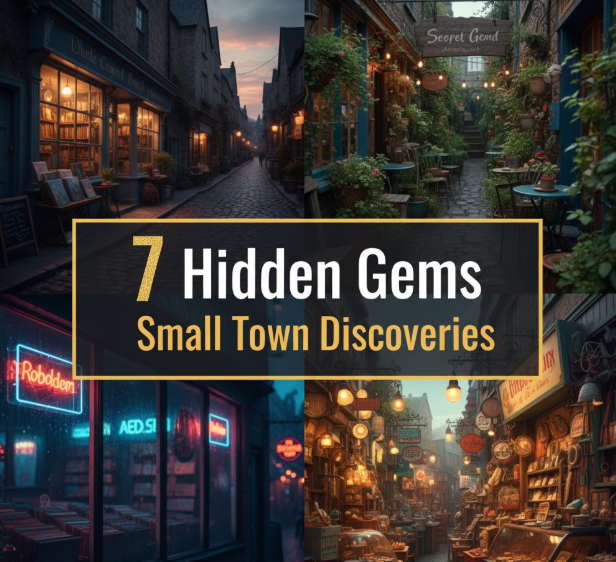
There is something about a small town that larger cities just cannot replicate.
The crooked main street. Nick and June’s diner that’s been open since 1953. The elderly man at the hardware store who memorizes every hiking trail.
Most travelers breeze through small towns on their way to the nearest metropolis. That’s their loss. And your advantage — if you know what to watch for.
In this guide, we will explore the 7 most underrated small town discoveries that are life-changing and underappreciated. These aren’t tourist traps. These are the actual destinations, under-the-radar corners, and secret experiences that leave you wondering, “Why didn’t anyone tell me about this before?”
Let’s get into it.
Why Small Towns Need a Second Look
Big cities are great. Nobody’s arguing that.
But when you’ve waited in line for 45 minutes at a hot brunch spot, squeezed between a hundred other tourists, you start to wonder whether there’s another way.
Small towns have something rare: the real deal.
Nobody’s performing for a camera. Nobody’s trying to go viral. Life just… happens. When you visit and stumble into it, it feels like stumbling into something real.
Studies repeatedly find that small-town visitors report a greater sense of connection, relaxation, and contentment than those who visit large tourist centers. These experiences linger long after, because they aren’t commercialized — they’re personal.
The best part? These insider tips are hiding in plain sight. You just have to know where to look.
Gem #1 — The Roadside Diner That’s Actually Worth It
Every small town has one.
You’ll recognize it at once: a slightly faded sign, a parking lot lined with pickup trucks, and a “Today’s Special” menu handwritten on a whiteboard in the window. This is not a chain. This is not some “inspired by” thing. This is the real thing.
Why You Should Always Stop
Roadside diners in small towns are living archives of local culture. The recipes are unchanged for decades. The staff knows all the regulars by name. And the food? It’s made with the sort of care that no corporate kitchen manual can reproduce.
Seek out diners that have existed for longer than 20 years. Those places have endured not due to marketing, but because the food is really good.
Order the daily special. It’s typically something fresh, or whatever the cook feels like making. Either way, it’s the most honest meal you’ll have on your trip.
What to Listen For
Sit at the counter — not a booth.
This is where you’ll hear everything: local gossip, recommendations, warnings about which road has a terrible pothole, and which farm stand has the best peaches. In 20 minutes at the counter, you will learn more about a town than any travel blog can tell you.
Pro tip: If the menu comes laminated and is two pages long, you’re probably safe. If it’s a single chalkboard sheet that changes daily, you’ve hit the jackpot.
Gem #2 — The Indie Bookshop With Character
Chain bookstores are fine. Small-town independent bookshops are unforgettable.
These establishments don’t operate like corporate stores. The mysteries might be sandwiched between cookbooks and local history. The owner might have shelved an obscure 1970s travel memoir alongside a best-selling thriller because they thought you’d like it.
That’s the point. These shops are curated by taste, not algorithm.
Finding the Good Ones
The finest small-town bookshops are typically housed in older buildings — above a café, inside a repurposed post office, or nestled between an antique store and a barber shop.
Look for handwritten recommendation cards from staff on the shelves. That’s a signal that an actual human being who really read these books wants to tell you about them. That advice is worth its weight in gold.
Many of these shops also carry local authors, regional history books, and small-press editions you won’t find anywhere else. If you’re a reader, schedule extra time and extra luggage space.
The Social Side
Small-town independent bookshops often act as community hubs.
They organize poetry nights, author readings, and book clubs. Should you luck out and be there on the right evening, you’ll find yourself in a living-room-style discussion with a dozen locals. You can’t put a price on that kind of experience.
Gem #3 — The Trail That Isn’t on Any Map
Every small town near a natural landscape has at least one trail that won’t show up on AllTrails, Google Maps, or any official tourism website.
Locals refer to it simply as “the path behind the water tower” or “the old logging road.” These trails are often better maintained than official ones — because the people who walk them actually care about them.
How to Find Them
Ask at the diner counter (see Gem #1). Ask at the bookshop (see Gem #2). Ask the person at your guesthouse or Airbnb.
The question to ask is targeted: “Is there a walk nearby that most tourists don’t know about?” That phrasing matters. Ask for “a good hike,” and you will be directed to the tourist trail. Ask for something off the map, and you’ll actually get it.
What Makes These Trails Special
These paths often lead somewhere that has no interpretation board, no parking lot, and no guardrail.
That might sound alarming. It’s actually freeing.
You may encounter a waterfall that locals have been swimming at for generations. You might come upon an overlook with a view that would be on every Instagram feed, if anyone could be bothered to post it. You may just find a quiet meadow where you can sit for an hour and hear absolutely nothing.
That kind of silence is becoming harder and harder to find. Small towns still have it.
Gem #4 — The Annual Festival Nobody Told You About
Small towns take their festivals seriously.
We’re not talking about a few food trucks and a bounce castle. We’re talking about events that have been running for 30, 50, sometimes over 100 years. Events where entire towns close down, where everyone knows each other, and visitors are genuinely welcomed — not tolerated.
The Greatest Small Town Festivals
Harvest festivals are held to mark the end of the growing season. Typically in September or October, they involve plenty of food, music, and community pride.
Historical reenactments are more common than you might think. Many small towns were the scenes of battles, frontier settlements, or founding moments that defined entire regions. These events bring that history to life in a way no museum can.
Arts and music festivals in small towns usually highlight local and regional talent. The lineups aren’t renowned, but the performances are spirited. You may find your new favorite band performing on the back of a flatbed truck in a town of 2,000.
How to Know When They Happen
Most small towns list their events on a town council or chamber of commerce website. These sites tend to be poorly designed and easy to overlook in search results — but they’re well worth hunting for.
The best approach is to simply ask locals. “Does your town have any big events coming up?” nearly always gets a response that lights people up. Everyone loves talking about their town’s festival.
Gem #5 — The Saturday Morning Artisan Market
This is one of the greatest small town discoveries of all time.
Forget the tourist market in the city where all the vendors sell the same imported trinkets. A real small-town artisan market is where local makers go to sell what they actually make.
For more inspiration on what to look for, Small Town Discoveries is a great resource for planning your next off-the-beaten-path adventure.
What You’ll Actually Find
Pottery thrown by someone with a kiln in their garage. Jam made from fruit grown 10 miles away. Woodwork carved during winter evenings. Soaps scented with herbs from a backyard garden.
These aren’t decorative items designed to look artisan. They are artisan products, full stop.
You’ll also find local farmers selling produce, eggs, and meat. You’ll meet a honey seller who can tell you precisely which field their bees worked this season. There are baked goods that disappear by 9:30 AM if you’re not out early.
The People Are the Point
The most charming thing about small-town markets isn’t the goods. It’s the conversations.
Every vendor has a story. Ask the woodworker how they learned their craft. Ask the jam maker what makes this season’s batch different. Ask the farmer what they’re growing next year.
These are the conversations travel memories are made of. Not the photo you took of the jam jar — the five-minute conversation with the person who made it.
What to Buy and What to Skip
| Buy | Why |
|---|---|
| Local honey | Hyperlocal, seasonal, unique flavor |
| Handmade ceramics | One-of-a-kind, lightweight to pack |
| Locally printed art | Supports artists, tells regional stories |
| Preserves and sauces | Taste of place you can bring home |
| Handmade soap | Long-lasting, beautifully made |
Gem #6 — The Historic Site That Has No Lines
Famous historic sites are great. Waiting 90 minutes to see them is not.
Small towns across the country — and around the world — are full of historic sites that are just as interesting as the famous ones. They just haven’t been marketed as aggressively.
Why Small Town History Hits Differently
Big city history can feel distant. It happened to kings and presidents in grand buildings you’re not allowed to touch.
Small town history feels personal. It happened to ordinary people — farmers, teachers, blacksmiths, immigrants — in buildings you can walk through, or ruins you can sit beside and actually contemplate.
Types of Historic Sites Worth Seeking Out
Old cemeteries are some of the most fascinating places in any small town. The headstones tell stories. They reveal patterns — the years of struggle, the waves of immigration, the families who built these places from nothing. Many old cemeteries are beautifully maintained and surprisingly peaceful.
Preserved main streets in small towns sometimes look exactly as they did 80 or 100 years ago. The architecture tells you what the town valued, what they built to last, and what mattered to people who lived very different lives.
Local museums in small towns are often run by passionate volunteers who know every object in the collection personally. These aren’t passive, glassed-off displays. These are curated love letters to a community, told by people who live there.
Ruins and remnants — old mills, abandoned railway depots, crumbling stone walls — are everywhere in small towns if you look. These places have a melancholy beauty that’s hard to describe but easy to feel.
According to the National Park Service’s Historic Preservation program, thousands of small towns across the US contain nationally significant historic sites that most visitors never discover.
Gem #7 — The Craft Brewery or Cidery That Sources Local
The craft drink revolution wasn’t confined to cities. It happened everywhere.
Small towns now boast some of the most interesting breweries, cideries, and wineries in the world. And since they aren’t competing for city foot traffic, they’ve had to do something different: go hyper-local.
What Sets Small Town Craft Drinks Apart
A small-town brewery that uses local grain, local hops, or local fruit isn’t just making a product. It’s making a place in a glass.
The apple cider from a cidery in a small orchard town tastes like that specific valley, that specific microclimate, those specific trees. You cannot replicate it anywhere else. That’s not marketing language — it’s agricultural fact.
The Experience Beyond the Drink
Small-town breweries and cideries tend to be relaxed, unpretentious places. Nobody’s going to look down on you for not knowing the difference between a saison and a grisette. The person pouring your drink is often the person who made it, and they’re generally more than happy to tell you about it.
Many of these places also host events: trivia nights, live music, farm-to-table dinners. They’ve become the de facto community gathering spots in towns that don’t have many other options.
What to ask: Inquire whether they source any ingredients locally. Ask what their seasonal or limited release is. Ask what the owner is most proud of. These three questions will start a conversation that lasts well past closing time.
How to Plan the Perfect Small Town Trip
Finding hidden gems isn’t just about knowing what to look for. It’s about showing up the right way.
| Strategy | Why It Works |
|---|---|
| Go on a weekday | Fewer crowds, more authentic interactions |
| Stay at a local guesthouse, not a chain hotel | Owners are your best information source |
| Leave the itinerary loose | The best discoveries happen when you wander |
| Talk to people over 60 | They know the history, the old spots, the stories |
| Come back | The second visit is always better than the first |
The biggest mistake travelers make in small towns is treating them like a checklist. You’re not there to tick boxes. You’re there to slow down and pay attention.
Small Town vs Big City Travel — A Quick Comparison
| Category | Small Town | Big City |
|---|---|---|
| Average cost per day | Lower | Higher |
| Crowds | Rare | Common |
| Unique experiences | High | Moderate |
| Local interaction | Very frequent | Less common |
| Discovery factor | Extremely high | Lower |
| Planning required | Minimal | Often significant |
FAQs About Small Town Discoveries
Q: Where can I find hidden gem small towns near me?
Start by looking for towns with a population under 10,000 within a 2–3 hour drive. Seek out towns with a historic main street, a local farmers market, or some natural feature nearby like a river, mountain, or forest. Road trip forums and local travel subreddits are excellent resources.
Q: Are small towns really safe for solo travelers?
Generally, yes. Small towns tend to have lower crime rates than urban centers. The bigger challenge for solo travelers is that many small towns have limited late-night options and public transportation. Renting a car and letting someone know your itinerary are both smart moves.
Q: What’s the best time of year to visit small towns?
It all depends on what you’re after. If harvest festivals, farm stands, and foliage are your thing, late summer through fall is ideal. Spring is glorious for wildflowers and reopened seasonal places. Winter visits are serene, though you’ll have to check ahead for what’s open.
Q: How can I tell if a small town is actually worth visiting?
Look for towns that contain at least one independent business that’s been around for over 20 years — a diner, a hardware store, a bookshop. That longevity indicates a true community with roots. Avoid towns that exist almost purely as “tourist villages” — those places have lost the authenticity that makes small towns special.
Q: Is it impolite to ask locals for suggestions?
Not at all — it’s one of the best things you can do. Most small-town residents are proud of where they live and happy to share it with curious visitors. Just be respectful of their time and genuinely interested in their answers. Don’t just ask about a photo op location. Ask what they enjoy about living there.
Q: Is there good food if I have dietary restrictions?
It’s getting easier. Many small towns now have at least one café or restaurant offering vegetarian or vegan fare. Farm stands and markets are naturally full of fresh produce. That said, some extremely rural places still trail behind. It’s worth checking menus online before you visit or calling ahead to inquire.
Q: Should I book accommodation far in advance for small towns?
It depends on the season and whether there’s a local event happening. Small towns can book out weeks in advance during festival weekends, as there are only so many places to stay. During off-peak times, you can often reserve a few days in advance with no problem. Local guesthouses and B&Bs sometimes aren’t listed on the major booking platforms, so check the town’s tourism website directly.
Conclusion — Quit Skipping Small Towns
The best travel experiences rarely photograph well or make for impressive brochures.
They’re the diner counter where a stranger told you about his grandfather. The uncharted trail that led to a breathtaking view. The name of the market vendor you still remember two years later.
These are the moments that small town discoveries are made of.
The seven hidden gems in this guide are not rare or hard to find. They’re everywhere, in every small town, waiting for someone patient enough to slow down and see them.
The next time you’re planning a trip, scroll past the big city and look at the small dot on the map just to the left of it.
That’s where all the good stuff is.