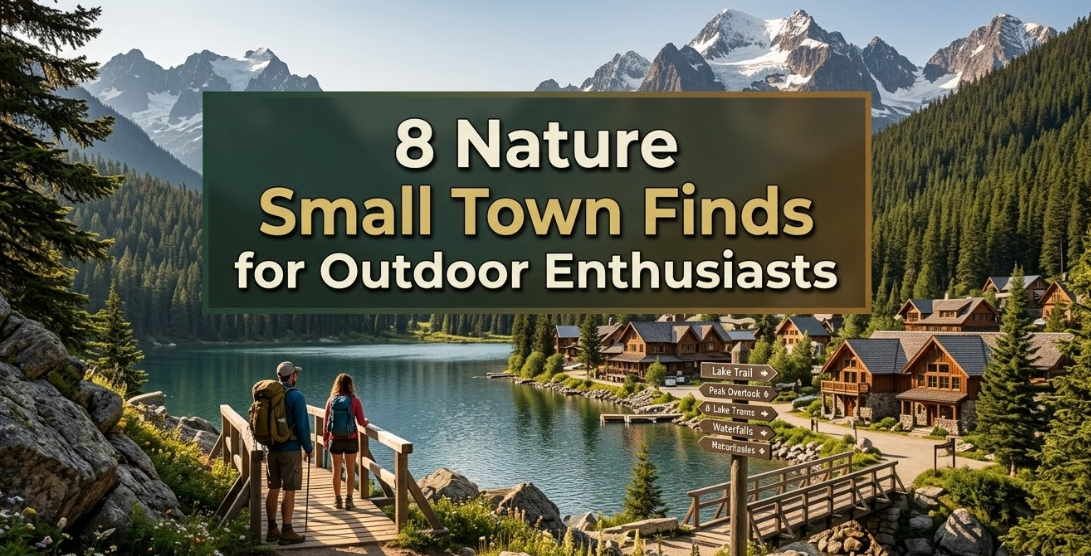
Big cities get all the press. But the real trick for outdoor enthusiasts? It lurks in small towns that most people pass right by. These places stand next to wild forests, roaring rivers, sky-high cliffs and trails that seem like they are yours alone.
If you love hiking, kayaking, birdwatching or just inhaling fresh mountain air, small towns are your best-kept secret. They provide access to nature without the crowds, sky-high prices or long wait times associated with well-known national parks.
This guide explores 8 stunning nature small town discoveries that visiting outdoor lovers need on their radar across North America. And each one is different — with lava fields, ancient forests or crystalline lakes. For even more hidden gems worth exploring, visit Small Town Discoveries — your go-to guide for off-the-beaten-path travel.
8
Hidden Towns Covered
3M+
Acres of Public Land Nearby
12+
Outdoor Activities Featured
Year-Round
Most Destinations Open
Why Small Towns Are the New Outdoor Travel Hot Spots
The outdoor recreation industry has boomed. Millions of people began hiking, camping and walking in nature for the first time after the pandemic. Crowds overwhelmed popular destinations like Zion, Yellowstone and the Great Smoky Mountains.
The result? Crowded trails, busy trailheads and a loss of that peaceful rapport with nature.
Small towns offer a way out. Many hug the borders of wilderness areas to match anything you’ll find out in the big parks — but without the tour buses, permit lotteries or parking mess. Local guides know secret trails. Small inns are a fraction of resort prices. And you can feel like you’ve actually discovered something.
More than 164 million Americans engaged in outdoor recreation in 2023, according to the Outdoor Industry Association. But fewer than two out of 10 went outside the top 100 visitor spots. The other 80% is wide open.
| Town | State / Region | Best Activity | Best Season | Crowd Level |
|---|---|---|---|---|
| Ouray | Colorado | Via Ferrata / Hot Springs | Summer–Fall | Low |
| Winthrop | Washington | Hiking / Cross-Country Ski | Year-round | Low |
| Mineral Bluff | Georgia | Whitewater Rafting | Spring–Summer | Very Low |
| Terlingua | Texas | Dark Sky Stargazing | Fall–Winter | Very Low |
| Leavenworth | Washington | Rock Climbing / Snow | Year-round | Moderate |
| Driggs | Idaho | Backpacking / Skiing | Summer–Winter | Low |
| Ely | Minnesota | Canoe Wilderness Trips | Summer–Fall | Low |
| Taos | New Mexico | Hiking / River Gorge | Spring–Fall | Moderate |
8 Nature Small Town Discoveries You’ve Got to Visit
1
Ouray, Colorado — “Switzerland of America”
Population ~1,000 · Elevation 7,792 ft
Cliffs, Hot Springs and Alpine Drama
Ouray is nestled in a narrow box canyon in the San Juan Mountains. The second you drive in, the walls close around you and the sky shrinks to a ribbon of blue. It’s one of the most dramatic small-town landscapes in all of North America.
The town is known for its natural thermal hot springs pools, which attract visitors year-round. But what really puts Ouray on the outdoor lovers’ map is the Ouray Via Ferrata — a system of iron rungs, cables and ladders affixed to sheer cliff faces. Even novices can ascend routes that would otherwise take expert mountaineering abilities.
What to Do Around Ouray
The annual Ouray Ice Park takes over the canyon gorge each winter and is considered to be the world’s first public ice climbing park. Each January, more than 200 ice climbing routes emerge. In summer, the gorge is a hiking corridor, with waterfalls around every bend.
Drive south along the Million Dollar Highway (US-550) toward Silverton for one of the most breathtaking stretches of mountain road in America. The road has stretches without guardrails — not for the faint of heart, but unforgettable.
Many local lodges offer free admission to the Ouray Municipal Hot Springs Pool, which is right in town. Water temperatures remain around 104°F year-round and are supplied by natural geothermal springs.
2
Winthrop, Washington — Gateway Into the North Cascades
Population ~450 · Methow Valley
Four Seasons of Outdoor Fun in One Valley
Winthrop is a small Old West-themed town in eastern Washington. But overlook the wooden boardwalks and saloon fronts — the terrain surrounding it is remarkable. Surrounding the Methow Valley are the peaks of the North Cascades, and more outdoor diversity per square mile exists here than almost anywhere in the Pacific Northwest.
In the winter, Winthrop serves as the anchor for the Methow Valley Nordic system — more than 120 miles of groomed cross-country ski trails, the largest such system in North America. In summer, the same trails are open for mountain biking and hiking.
Beyond the Trails
The Methow River runs right through the town and has great fly fishing. A 30-minute drive northwest finds you in the Okanogan-Wenatchee National Forest, where trailheads lead into remote backcountry that all but never sees a visitor. These forests are home to wolves, black bears, lynx and golden eagles.
The valley is also located within one of Washington’s driest rain shadows, which means it receives more than 300 sunny days each year — a rarity in the Pacific Northwest.
3
Terlingua, Texas — Desert Nightfall and Big Bend Country
Population ~58 · Chihuahuan Desert Edge
The Darkest Skies in the Lower 48
Terlingua is barely a town. It is a bit of a ghost town turned artists’ colony, just outside the gates of Big Bend National Park. No traffic lights, no chain restaurants and nearly zero light pollution. That last part is the key.
The skies above Terlingua and Big Bend are some of the darkest in the continental United States. On a clear night, the Milky Way can be seen stretched from horizon to horizon in all its glory. The Chisos Mountains erupt from the desert like an all-too-foreign volcanic island, and the Rio Grande literally slices a canyon 1,500 feet deep just down the road.
Desert Outdoor Adventures
Hiking in Big Bend is surreal. The South Rim Trail is a two-day backpacking loop in the Chisos Mountains, with vistas extending into Mexico on clear days. The Santa Elena Canyon Trail is a short and dramatic hike between two sheer limestone cliffs as the Rio Grande squeezes between.
From Terlingua, you can rent canoes or kayaks and paddle the Rio Grande through canyons that seldom see another soul. Temperatures are optimal October to March.
Why You’ll Love It
- World-class dark sky stargazing
- Unique desert-mountain ecosystem
- No crowds, ever
- Affordable and remote lodging
Things to Know
- Summer heat can exceed 110°F
- Cell service is very limited
- A 3+ hour drive to the nearest large city
- Water is in short supply — bring lots of it
4
Driggs, Idaho — The Quiet Side of the Tetons
Population ~1,700 · Teton Valley
Same Mountains, All the Peace
Everyone knows Jackson Hole, on the Wyoming side of the Teton Range. Driggs, Idaho, which lies on the western slope of those very same mountains, is far less known. The views may be better — you face the dramatic eastern face of the Tetons dead-on across flat farmland, with no development blocking the skyline.
Driggs is the base camp for Grand Targhee Resort, which receives more natural snowfall than almost any resort in America. It’s a powder paradise that the Jackson Hole crowd mostly overlooks. Lift lines are short, prices are low and the mountain is just as wild.
Summer in Teton Valley
Driggs is a backpacker’s dream in summer. North and south of the Teton crest, the Jedediah Smith Wilderness is accessible from trailheads that see only a fraction of the crowds on the Wyoming side. You could walk for days without encountering another soul.
The Teton River south of Driggs is a favored fly-fishing spot, and the valley’s flat landscape makes it an excellent road cycling destination with 13,000-foot peaks in view on the horizon.
5
Ely, Minnesota — Canoe Country at the Edge of the World
Population ~3,400 · Gateway to Boundary Waters
A Million Acres of Waterway Wilderness
Ely is the primary access point to the Boundary Waters Canoe Area Wilderness (BWCAW) — one million acres of linked lakes, rivers and portage trails along the US-Canada border. Most of the wilderness does not permit motorized boats. No roads penetrate it. It’s one of the most visited wilderness areas in the United States, but still feels utterly wild.
The canoe culture here is deeply intertwined with life. For more than a century, outfitters in Ely have been renting canoes and plotting routes. Rent everything from a solo canoe to a full guided expedition into the interior.
Wildlife, Wolves, and Northern Lights
The BWCAW has one of the healthiest wolf populations found in the lower 48 states. You might hear them at night from your campsite. Moose, black bears, bald eagles, loons and river otters are all commonly seen.
From late August to March, Ely’s northern latitude (47°N) offers an excellent chance of seeing the Northern Lights (Aurora Borealis). The total darkness of the wilderness makes for truly spectacular displays.
The BWCAW requires an overnight trip permit. Day trips are free. Reserve early — they’re in high demand for July and August. The wilderness features more than 1,200 designated campsites only reachable by canoe.
6
Mineral Bluff, Georgia — Hidden Appalachian Whitewater
Population ~500 · The Blue Ridge Mountains
Where the Appalachian Mountains Meet the Water
Mineral Bluff is located in the Blue Ridge Mountains of north Georgia, near where the Toccoa River joins a number of other fast-flowing streams. It is an extremely rural place most people have never heard of — and that’s precisely why it deserves a spot on this list.
The area is located in the Chattahoochee-Oconee National Forest and close to the Ocoee River, which hosted the whitewater kayaking events for the 1996 Olympics. Today, the Ocoee’s Upper section is one of the most extreme Class IV-V whitewater runs in the eastern United States.
Trails and Trout
For hikers, the adjacent Cohutta Wilderness is a spectacular assemblage of ridgelines, gorges and old-growth hemlock woods. The Jacks River Trail includes more than 40 river crossings and rewards those who finish it with one of the most remote canyon experiences in the Southeast.
The Toccoa River tailwater below the dam is one of the best sites in the South for trout fishing. Cold, clear water sustains a healthy trophy rainbow trout fishery year-round.
7
Leavenworth, Washington — A Cascade Climbing Mecca
Population ~2,300 · Wenatchee National Forest
Everything From Rock, to Snow, to River
Leavenworth is known for its Bavarian-themed downtown, which draws tourists during Oktoberfest and Christmas lighting festivals. But don’t be distracted by the lederhosen — the outdoor scene is serious business.
The town lies in the Icicle Creek canyon, edged by jagged granite walls. Castle Rock, Peshastin Pinnacles and the Tumwater Canyon walls have drawn rock climbers for decades. It offers over 600 known climbing routes from beginner slabs to multi-pitch trad climbs.
Year-Round Adventure Options
In the winter, the Stevens Pass ski area is just 35 minutes away. The groomed trails at Lake Wenatchee and Icicle Creek are a favorite with cross-country skiers. In the spring, whitewater on the Wenatchee River draws kayakers from all over the Pacific Northwest.
Summer offers prime access to mountain biking the Enchantments-area trails, and backpacking into the Alpine Lakes Wilderness — one of the prettiest high-country terrains in the Cascades.
8
Taos, New Mexico — Gorge, Desert and Sacred Peaks
Population ~5,700 · Sangre de Cristo Mountains
A Landscape That Defies Description
Taos is a formidable overachiever. It has the art galleries and adobe architecture of a cultural destination, yet is only minutes from landscapes that seem prehistoric. The Rio Grande Gorge — a 650-foot-deep chasm that cleaves that flat desert plateau — ranks high among the most jaw-dropping geological features of the American Southwest.
Stand on the bridge above the gorge and gaze down. The Rio Grande is a thin strip of silver far below. Raptors ride thermals at eye level. It is that kind of place where you really feel tiny — in the best way.
Mountain and Desert Outdoor Experiences
Taos Ski Valley, which is 20 miles from town, receives more than 300 inches of snow a year. While the ski area is legendary for expert terrain, beginners and intermediates have their share of runs as well. The Wheeler Peak Wilderness above Taos features the highest summit in New Mexico, at 13,161 feet.
The neighboring Rio Grande del Norte National Monument, to the west of town, has a network of trails through volcanic landscape that few bother with. Wild mustangs gallop across the plateau. Mule deer and pronghorn are everywhere.
The Rio Grande Gorge Trail stretches along the rim and down into the canyon bottom. The lower section runs along the river and can be paired with a class III-IV raft trip through the Taos Box — one of the best one-day whitewater trips in the Southwest.
How to Plan Your Nature Small Town Getaway
Timing Is Everything
Seasonality matters for each of these locales. Mountain towns such as Ouray and Driggs are best visited in summer and early fall before snow closes passes. Desert spots such as Terlingua are best from October to April. Always check the road and trail conditions before you go — things can change fast.
Stay Local, Support Local
Small towns rise and fall with their local economies. Skip the highway chain motel and find a room at the local inn or nearby vacation rental. Eat at the diner in town. Hire a local guide. Your dollars stretch a lot farther — and your experience will be much richer.
| Trip Type | Best Town Match | Required Skill Level | Estimated Budget / Day |
|---|---|---|---|
| Family hike | Winthrop, Leavenworth | Beginner to intermediate | $80–$150 |
| Solo backpacking | Driggs, Ely | Intermediate to advanced | $40–$90 |
| Winter sports | Ouray, Driggs | All levels | $120–$200 |
| Stargazing / astronomy | Terlingua | None required | $60–$110 |
| Whitewater paddling | Mineral Bluff, Taos | Intermediate to expert | $70–$140 |
| Wildlife watching | Ely, Winthrop | None required | $60–$120 |
Pack for the Wild, Not the Mall
Small outdoor towns often have little in the way of gear. Bring what you need. A solid pair of hiking boots, a rain layer, a good headlamp and a water filter will get you through just about any destination on this list. Check ahead — some wilderness areas and parks have specific gear requirements, like bear canisters.
A New Trend in Outdoor Travel: Slow Travel
Travel culture is shifting. More people are swapping one-week resort trips for long stays in small, rugged places. This trend — known in some circles as “slow travel” or “outdoor immersion” — aligns ideally with nature small towns.
Instead of racing through five national parks in seven days, devote a full week to Ely, paddling deeper into the Boundary Waters each day. Rather than heading to the Zion main trail with 5,000 other souls, spend a week in Driggs gradually discovering the Teton backcountry. The depth of experience you get is second to none.
Frequently Asked Questions (FAQs)
Are these nature small towns safe for solo travelers?
Yes, all eight towns are generally very safe. But going solo in the wilderness takes additional planning. Always inform someone of your route, carry a satellite communicator (like a Garmin inReach) and know your limits. The greatest dangers in any of these places stem from interactions with wildlife, sudden changes in the weather and getting lost in out-of-the-way terrain — all avoidable through preparation.
Do I need a car to visit these outdoor small towns?
In most cases, yes. These are rural locations with little to no public transportation. A car — preferably one with reasonable clearance for unpaved forest roads — is nearly mandatory. Some outfitters in towns like Ely and Winthrop provide shuttle services for certain trips.
Which of these towns are best for first-timers who have never done outdoor adventures?
Leavenworth and Winthrop are both terrific places to start. Both have established trail systems, active local outfitter communities and various levels of difficulty. Ely is also great for beginners who want to paddle — outfitters there can teach you canoeing basics before you hit the wild.
What is the ideal season to visit these nature small towns?
It depends on the destination. Mountain towns (Ouray, Driggs, Leavenworth) peak in summer and early fall. Desert towns (Terlingua, Taos) are ideal in fall through early spring. Ely and Winthrop are great year-round depending on your activity. The best season for each town is covered in the table earlier in this article.
How do I find accommodation in these small outdoor towns?
These towns typically have a variety of small inns, cabins, vacation rentals and campgrounds. Make reservations early — particularly for peak seasons — as availability is extremely limited. Use search platforms such as Hipcamp and Tentrr to find unique outdoor stays in your area. Smaller lodges sometimes do not appear on major booking sites, but local tourism websites will list them.
Which of these destinations are good for kids and families?
Absolutely. Winthrop, Leavenworth and Ely are especially family-friendly. The flat valley trails in Winthrop are easy for young children. Canoe outfitters around Ely take families on regular runs. Leavenworth has gentle riverside strolls and kid-friendly climbing gyms. Kids of all ages love Ouray’s hot springs.
Is there good internet and phone service in these towns?
In town, phone service is generally good, but coverage falls off steeply as soon as you get out into the wilderness. Overall, Terlingua has the least reliable service. If you need to stay connected — or would like a safety net in remote areas — investing in a satellite communication device is worth it for any serious outdoor trip.
The Trail Begins in a Small Town
The finest outdoor experiences don’t always have renowned names behind them, or a lot of busy Instagram feeds. They stem from opting for a silent valley over a busy park. A dirt trailhead rather than a paved tourist’s path. A local outfitter instead of a big-brand resort.
These eight nature small-town finds are invitations. Each one leads to a landscape that feels intimate, untamed and very much off the well-worn path. Whether you’re hunting powder in Driggs, paddling into the Boundary Waters from Ely or stargazing at the Milky Way from a cot outside Terlingua — it’ll be an experience that sticks with you long after the trail ends.
Pick one. Go. The great outdoors is waiting — and it doesn’t care how many followers you have.