
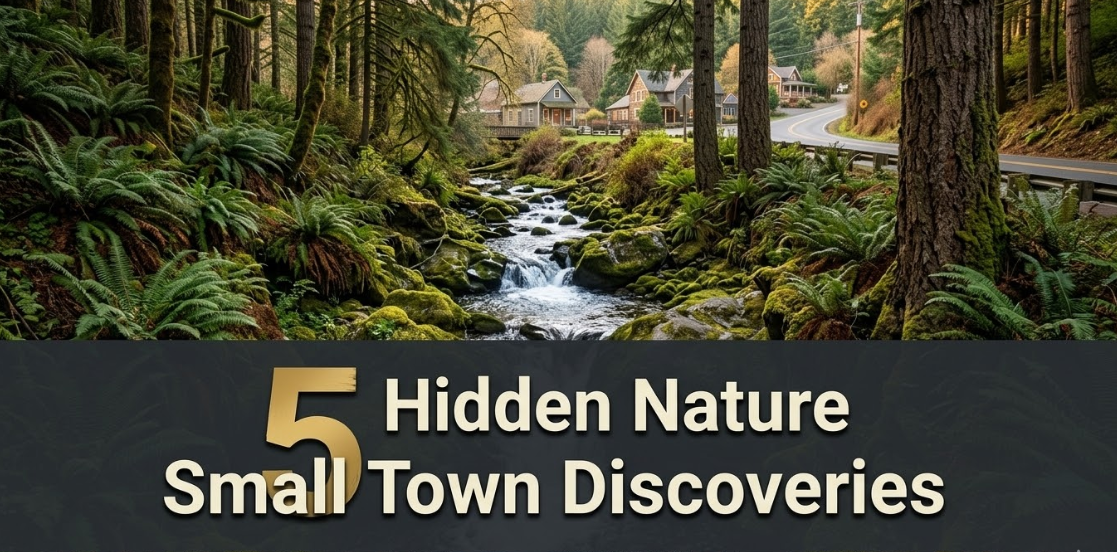
When most people want to get close to nature, they think big national parks. Yellowstone. The Grand Canyon. Yosemite. These are amazing places — no question. But they’re also teeming with tour buses, clogged trailheads and sky-high hotel prices.
What if the most rewarding nature experiences in America were tucked away somewhere much more tranquil?
They are. And they reside within little towns that most people drive straight past.
These five hidden nature small town discoveries are not on every travel blog. You aren’t going to see them on a billboard. But each of them offers jaw-dropping terrain, rare wildlife and the kind of serenity you won’t find at a tourist hotspot.
The best way to learn about them is the slow road, so come with me while we explore them, one by one.
1. Brevard, North Carolina — The Waterfall Town That Surprises Everyone
Blue Ridge Mountains, NC
A Forest With 250+ Waterfalls? Yes, Really.
Nestled in the Blue Ridge Mountains of western North Carolina, Brevard is a town of about 8,000 residents. But just outside its door is something remarkable — Pisgah National Forest, which has more than 250 named waterfalls.
That number is not a typo.
From the thundering, three-tiered Looking Glass Falls to the narrow chute of Sliding Rock (a natural water slide frequented by thousands of locals each summer), the diversity here is stunning. You can chase waterfalls for three days straight and still never really see them all.
The forest itself is more than 500,000 acres. Trails range from gentle 20-minute strolls to full-day ridge hikes with panoramic views of the Appalachian range. Common sightings include black bears, white-tailed deer and wild turkeys.
The White Squirrels of Brevard
Here’s the thing that makes Brevard special. The town has a rare colony of white squirrels. These are not albinos — they are a genetic variant of the Eastern gray squirrel with white fur and dark eyes. They zip around lawns, parks and even downtown streets.
Brevard is so proud of these little guys that it holds an annual White Squirrel Festival each spring.
When to Go and What to Bring
| Season | Highlights | Notes |
|---|---|---|
| Spring (Apr–May) | Waterfalls at peak flow, wildflowers | Trails may be muddy |
| Summer (Jun–Aug) | Sliding Rock, tubing, swimming holes | Busiest season |
| Fall (Sep–Nov) | Explosion of leaf color, cool temperatures | Best photography season |
| Winter (Dec–Feb) | Frozen waterfalls, quiet trails | Some roads may close |
Bring waterproof hiking boots, a rain jacket and a sense of wonder. Pisgah has spotty cell service, which — let’s be honest — is part of the charm.
2. Leavenworth, Washington — Where Salmon Run Through a Bavarian Dream
Cascade Mountains, WA
A Mountain Town With a Dual Identity
At first glance, Leavenworth appears like it was plucked from a Bavarian village and deposited into the Cascade Mountains of Washington State. The buildings are Alpine in style, the streets smell of pretzels and pine, and snow-capped summits loom behind every storefront.
But beneath the lovely exterior, this small town of about 2,000 people is nestled within one of the Pacific Northwest’s most gorgeous natural corridors.
The Wenatchee River runs through town. The Icicle Creek canyon cuts through wilderness just west of Main Street. And the Cascades — with their glaciers, old-growth forests and rocky summits — are mere minutes away.
The Salmon Run Nobody Is Talking About
Chinook salmon return to the Wenatchee River each fall to spawn. You can walk out on a bridge over Icicle Creek and, peering down into the crystal-clear water, watch massive fish pushing upstream.
It’s one of those things you just have to see in person to believe.
The salmon migration draws bald eagles, osprey, black bears and river otters — all hunting along the same stretch of water. It’s a whole ecosystem unfolding before your eyes — and most visitors are walking right past it on their way to the sausage shops.
Hiking the Cascades from Town
The Enchantments — one of the most picturesque backcountry regions in the entire United States — is accessed via Icicle Creek Road just outside Leavenworth. Overnight permits are required, but day hikes along the lower trails offer jaw-dropping views without the lottery system.
Other top trails nearby include:
- Icicle Ridge Trail — 7.6 miles with panoramic valley views
- Snow Lake Trail — 8 miles round trip to an alpine lake surrounded by granite
- Tumwater Canyon — a riverside stroll ideal for beginners and families
Leavenworth sits at about 1,165 feet elevation, but the surrounding peaks rise above 9,000 feet. Weather shifts fast here. Always carry layers.
3. Taos, New Mexico — High Desert, Deeper Skies
Sangre de Cristo Mountains, NM
The Gorge That Stops You in Your Tracks
You could be cruising a flat stretch of New Mexico desert, sagebrush and dust at your windows, when — suddenly — the earth splits open.
The Rio Grande Gorge plunges 800 feet straight down, carved over millions of years by the river coursing through its base. Stretching across that chasm is the Rio Grande Gorge Bridge, one of the highest bridges in the United States.
Most people take a photo and keep moving.
Those who linger — who hike down the rim trail or follow the river path through the gorge floor — discover something magnificent. Ancient rock formations. Bighorn sheep on the canyon walls. Rafting through Class III and IV rapids on water so cold it takes your breath away.
Where the Sky Becomes Part of the Show
Taos sits at 6,969 feet above sea level. The air is thinner, drier and cleaner than just about anywhere in the lower 48 states. Outside town, light pollution is practically nonexistent.
That is what makes Taos one of the best locations for dark sky stargazing in North America.
On clear nights, the Milky Way spills across the desert like a river of light. Jupiter, Saturn and even nebulae are visible with the naked eye. The area around Taos Ski Valley organizes stargazing sessions in winter, complete with guided telescopes and hot cocoa.
The Painted Desert Ecosystem
The landscape surrounding Taos supports an unexpectedly rich ecosystem. Mule deer, coyotes, pronghorn antelope and red-tailed hawks are prevalent. The Taos Pueblo — a living Native American community continuously inhabited for more than 1,000 years — sits at the base of the Sangre de Cristo Mountains and offers tours, including walks along its mountain streams.
Wildflowers fill the high desert from late June through August. Each October, aspens turn golden on the mountain slopes, creating some of the most photographed fall foliage in the Southwest.
4. Hot Springs, Arkansas — Nature Bubbling Up From the Earth
Ouachita Mountains, AR
A Town Built on Geothermal Energy
Hot Springs is most commonly known as a center for bathhouses. And yes — the 47 thermal springs that gave this city its name still flow at a natural temperature of 143°F (62°C). You can drink the water straight from a fountain on Bathhouse Row, where it has been cooling to a safe temperature for more than 100 years.
But the natural wonder here extends well beyond warm water.
Quartz Crystal Country
Hot Springs sits within a region that geologists call the Ouachita Mountains — some of the oldest mountain ranges in North America, formed over 300 million years ago. These mountains are packed with quartz crystals.
And the fun part is: you can dig your own.
Several crystal mines around the Hot Springs area, including Wegner Crystal Mine and Ron Coleman Mining, let visitors dig through the earth and keep what they find. Kids go absolutely wild for this.
The crystals here are prized worldwide. Arkansas produces about 70% of the world’s naturally occurring quartz, and the clusters found near Hot Springs are among the largest and clearest.
Ouachita National Forest — Miles of Trail With Almost No One on Them
The Ouachita National Forest covers nearly 1.8 million acres across Arkansas and Oklahoma. The Ouachita National Recreation Trail stretches 223 miles from west of Hot Springs all the way to Oklahoma — one of the longest trails in the southern United States.
Yet it is quietly one of the least-hiked long trails in the country.
Why? Because it lacks the publicity of the Appalachian Trail or the Pacific Crest Trail. That means solitude. Miles of hardwood forest, ridgeline views, clear streams and not a single Instagram-famous viewpoint to lure the masses.
Wildlife is abundant here. Armadillos, river otters, wild hogs, great blue herons and even occasional black bears all call this forest home.
| Trail Name | Length | Difficulty | Best Feature |
|---|---|---|---|
| Hot Springs Mountain Trail | 4 miles | Easy | Tower views, wildflowers |
| Sunset Trail | 10.5 miles | Moderate | Loop through dense forest |
| Ouachita Nat. Rec. Trail (section) | Up to 223 miles | Varies | Wilderness solitude |
| Lake Ouachita Vista Trail | 1.5 miles | Easy | Lakeside overlook |
5. Beaufort, South Carolina — Sea Islands, Dolphins and Tidal Magic
South Carolina Coast, SC
A Coastal Town Hiding an Entire Ecosystem
Beaufort (pronounced “Byoo-fert” by locals, a fact they’ll correct you on right away) is a small historic town on the South Carolina coast. The streets are lined with antebellum homes, Spanish moss drips from live oaks, and the pace of life slows the moment you cross the bridge.
But surrounding this quiet town is one of the most ecologically rich environments in North America — the South Carolina Sea Islands.
These barrier islands and tidal marshes stretch for miles in every direction. The marshes serve as nurseries for dozens of fish species, feeding grounds for wading birds, and habitat for everything from painted buntings to loggerhead sea turtles.
Dolphins in the Marsh
The bottlenose dolphins of Beaufort have developed a behavior seen in only a few places on Earth.
Called strand feeding, it involves a pod of dolphins working together to herd fish onto a muddy bank. The dolphins then lunge partially out of the water to grab fish stranded on the shore, before rolling themselves back into the water.
You can watch this from a kayak in the tidal creeks. Local outfitters such as Beaufort Kayak Tours run early morning trips specifically to observe this phenomenon.
The Gullah Geechee Cultural Landscape
The Sea Islands were isolated from mainland South Carolina for centuries. That isolation allowed the descendants of enslaved Africans — the Gullah Geechee people — to preserve a remarkable amount of their West African language, foodways, crafts and spiritual traditions.
Visiting Beaufort means encountering this living culture. The landscape itself is part of the story — the sweetgrass baskets, the prayer trees, the hand-carved oyster roasting pits — all of it intertwined with the natural environment in ways that make this place truly unlike anywhere else.
What Makes These Small Towns Special — A Side-by-Side Look
| Town | State | Top Nature Feature | Unique Factor | Best Season |
|---|---|---|---|---|
| Brevard | NC | 250+ waterfalls | White squirrel colony | Fall |
| Leavenworth | WA | Cascade trails | Wild salmon run | Fall |
| Taos | NM | Rio Grande Gorge | Dark sky stargazing | Summer/Fall |
| Hot Springs | AR | Thermal springs | Crystal mining | Spring |
| Beaufort | SC | Sea island marshes | Dolphin strand feeding | Spring/Summer |
How to Plan Your Trip Without Overspending
Small-town nature travel is naturally budget-friendly. But a little planning can take you a long way.
Book accommodations early for fall. Brevard and Leavenworth in particular fill up quickly in October when leaf color peaks. Prices can double in the final two weeks before peak foliage.
Bring your own food for trail days. Small towns often have limited dining options near trailheads. A cooler with sandwiches saves money and keeps you flexible.
Check local outfitter websites before you go. Kayak tours in Beaufort, crystal mine reservations in Hot Springs and rafting permits on the Rio Grande all have limited spots. Book at least two weeks ahead.
Download offline maps. Cell service disappears fast in places like Pisgah National Forest and the Ouachita backcountry. Both Google Maps and AllTrails support offline downloads.
Talk to locals. Every small town has a coffee shop or a hardware store where the locals hang out. Ask where they take their kids on weekends. That’s where the real gems are.
Frequently Asked Questions
Q: Are these small towns safe for solo travelers?
Yes. All five towns have active tourism infrastructure and are considered safe destinations. As with any outdoor travel, solo hikers should always let someone know their planned route and expected return time.
Q: Do I need special permits to hike in these areas?
It depends on the specific activity. The Enchantments near Leavenworth require overnight permits. Rio Grande rafting may require a user fee. Most day hikes in the areas listed are free and permit-free. Always check the local forest service or park service website before your trip.
Q: What’s the best age range for families visiting these spots?
All five towns are family-friendly. Brevard’s waterfall walks are stroller-accessible in some sections. Hot Springs crystal mining is a hit with children ages 5 and up. Beaufort’s kayak tours accommodate kids as young as 8.
Q: Can I visit multiple towns in one road trip?
Absolutely. Brevard and Beaufort are both in the Southeast and can be combined into a week-long trip. Leavenworth and the Cascades pair naturally with any Pacific Northwest itinerary. Taos and Hot Springs can be connected via a road trip through the South-Central United States.
Q: What wildlife should I know how to respect before visiting?
Black bears are present near Brevard and Hot Springs. Never feed them, store food properly and make noise on trails. In Beaufort, maintain a 50-yard distance from dolphins in the water. In Taos, watch for rattlesnakes on rocky desert trails, especially in summer.
Q: Are these destinations accessible year-round?
Most are, yes. Leavenworth’s higher elevation trails may be snow-covered from November through May. Taos’ ski valley is actually a winter draw. Beaufort’s mild coastal climate makes it a rare year-round destination.
The Quiet Places Are Worth Finding
Big-name destinations will always have their appeal. But there’s something special about discovering a place that doesn’t need a marketing campaign — a town where the river runs clean, the trails are empty at sunrise, and the locals are genuinely happy to see you.
These five hidden nature small town discoveries represent that kind of travel. They reward the curious. They punish no one for going slowly. And every single one of them has a moment — standing under a waterfall, watching a dolphin lunge onto a muddy shore, or watching the Milky Way appear above a canyon rim — that will stay with you long after you’ve returned home.
The road less traveled is still out there. You just have to take the next exit.